
According to reports, researchers at the Swiss Federal Institute of Technology in Lausanne (EPFL) have made a significant discovery, identifying a new type of plasma radiation that could prevent overheating in tokamak fusion reactors while helping to dissipate excess heat, potentially improving reactor performance.
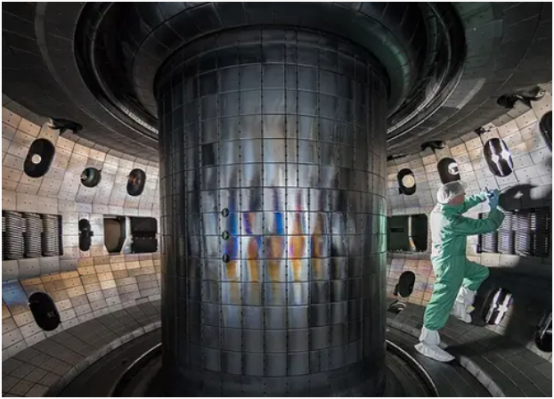
The technology, named the X-point Target Divertor (XPTR), provides new ideas for addressing key challenges faced by future fusion power plants. "Reducing the heat load on the divertor is a critical challenge for future fusion power plants," said Kenneth Lee, one of the researchers, in an interview with Phys.org. He further added: "One promising approach is the X-point radiator, which dissipates plasma energy near the X-point, but its scalability is uncertain due to its proximity to the core. We have experimentally studied the effect of adding a secondary X-point along the divertor channel to expand the operational range while maintaining core plasma confinement—this concept is known as the X-point target divertor."
Nuclear fusion is the process where two light atoms (such as hydrogen) combine to form a heavier atom (such as helium), releasing enormous energy, similar to how the sun generates energy. To apply nuclear fusion technology on Earth, scientists are working to replicate it as a clean, powerful electricity source that emits no greenhouse gases. The tokamak reactor, as a potential solution, uses toroidal strong magnetic fields to capture and heat a high-temperature gas called plasma. This plasma reaches extremely high temperatures and behaves like a current-carrying fluid; if it can be maintained stably for a sufficient time, fusion occurs.
However, the fusion process releases a large amount of heat, and some of this heat leaks out to strike the inner walls of the tokamak, particularly in the divertor region. The divertor is the area where excess plasma and heat are exhausted, and prolonged exposure to heat can damage the reactor, affecting its stable operation.
The EPFL team may have found a workaround to reduce the heat load on the tokamak's inner walls. Typically, the X-point is the location near the bottom of the tokamak device where magnetic field lines converge, guiding plasma to be exhausted there. In the new design, the research team added a second X-point deeper in the plasma exhaust channel. This additional X-point allows heat to be dissipated more evenly from the reactor core, reducing damage to the reactor while maintaining plasma stability, which is crucial for minimizing heat in the reactor's most vulnerable areas.