
Land-use change and the increased use of agrochemicals driven by agricultural intensification have significantly impacted global farmland biodiversity and associated ecosystem services. Vineyards, as agroecosystems of high ecological, cultural, and economic importance, are particularly vulnerable and face numerous pest threats, yet only a small fraction currently adopt sustainable management practices.
Under suitable conditions, however, vineyards can support diverse predator communities that provide effective natural pest control. Among these, birds and bats play a crucial role by consuming large numbers of insect pests, although their contribution to biological control in European perennial crops has been understudied.
Researchers from the HUN-REN Centre for Ecological Research and the University of Milan recently investigated the role of flying vertebrate predators—birds and bats—in natural pest control in vineyards. Published in the Journal of Applied Ecology, the study shows that these predators not only help regulate pest populations but also deliver economic benefits to farmers.
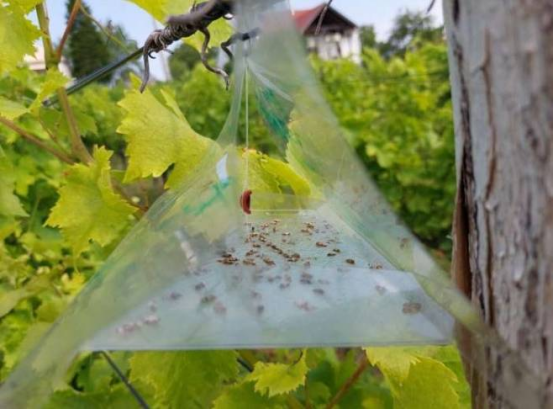
The team conducted exclusion experiments in Hungarian vineyards under different pest management regimes (organic vs. integrated pest management) and landscape contexts (forest-dominated vs. open agricultural landscapes). They assessed the effects of birds and bats on arthropod density and related ecosystem functions, recording bird density, bat activity, populations of the key grape pest—the European grapevine moth (Lobesia botrana)—as well as herbivorous and predatory arthropods in the canopy. Fruit damage by moths, herbivory rates in the canopy, and predation pressure were also evaluated.
Results revealed that forest landscapes supported higher bird and bat activity in spring and led to reduced fruit damage, primarily due to increased bat activity suppressing moth populations. While management regime had no clear effect on bird or bat presence, organic vineyards harbored higher canopy arthropod abundance, more leaf herbivores, and greater predation pressure on sentinel caterpillars. Most importantly, fruit damage and herbivory rates were consistently higher in exclusion treatments, underscoring the critical role of birds and bats in reducing herbivory and increasing crop yield.
Lead researcher Dávid Korányi explained that maintaining landscape connectivity with native deciduous forest patches, hedgerows, and small tree clumps promotes the presence of these predators by providing abundant food sources and suitable nesting or roosting sites.
Senior author Péter Batáry added that the study also highlights the importance of local vineyard management: organic practices further enhance pest control services by avoiding herbicides and synthetic insecticides, thereby promoting beneficial arthropod colonization and increasing predation pressure on pests within vineyards.