
Amid the global resurgence of nuclear energy projects, the safety of nuclear waste disposal and public trust remain major concerns. Recently, a joint team from MIT, Lawrence Berkeley National Laboratory, and the University of Orléans published a study in the Proceedings of the National Academy of Sciences (PNAS). By cross-validating a new high-performance computing model with 13 years of experimental data from Switzerland's Mont Terri Underground Research Laboratory, they provided a key tool for long-term safety assessment of underground nuclear waste disposal, potentially advancing policy-making and public acceptance.
Technical Breakthrough: 3D Simulation Overcomes Limitations of Traditional Models
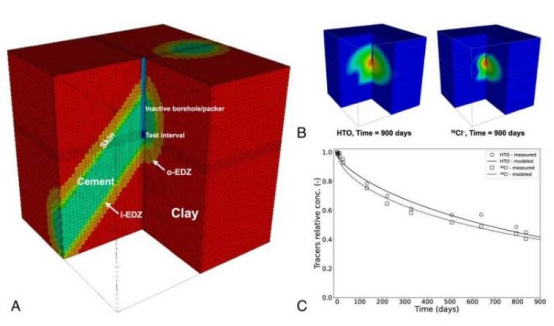
The team's CrunchODiTi software is the first to incorporate electrostatic effects into three-dimensional simulations of interactions between nuclear waste and geological materials, addressing errors in traditional models that ignore the charged properties of clay minerals. Built on an upgrade of CrunchFlow, the software runs in parallel on high-performance computers and successfully reproduced the migration of radionuclides at the cement-clay rock interface ("skin" region) observed in the 13-year Mont Terri experiments. The high agreement between experimental and simulation data validates the model's reliability for predicting long-term reactions in complex geological conditions.
International Collaboration: Real-World Validation of Computational Tool
Since 1996, Switzerland's Mont Terri Underground Research Laboratory has served as a core international platform for nuclear waste disposal research, providing decades of long-term data on interactions between Opalinus clay rock and engineered barrier materials. Lead author Dauren Sarsenbayev noted: "The multi-decade dataset from this site offers an irreplaceable benchmark for validating the model's performance in real geological environments." By comparing interface changes after injecting mixed positive and negative ion solutions in experiments, the team quantified the inhibitory effect of clay mineral electrostatics on radionuclide migration for the first time, providing scientific basis for optimizing geological repository designs.
Application Prospects: Reshaping Safety Assessment Systems
The new model can replace traditional tools to evaluate the long-term performance of different geological media (such as clay rock and salt layers) as nuclear waste storage mediums. Sarsenbayev emphasized: "The model can predict radionuclide behavior over thousands of years, helping decision-makers select optimal material combinations." For example, if the United States advances geological repository construction, this technology could significantly reduce site selection risks. The team plans to combine machine learning to develop lightweight surrogate models for improved computational efficiency.
Social Value: Interdisciplinary Fusion Boosts Public Confidence
The research integrates computational science, geological engineering, and public policy analysis, aligning with MIT's Department of Nuclear Science and Engineering's core philosophy of "science · systems · society." Assistant Professor Haruko Wainwright stated: "Combining high-performance computing with real-world experiments is key to building trust in nuclear waste disposal." With more experimental data to be released this month, the team will further refine the model and promote its application in global nuclear waste management projects.