
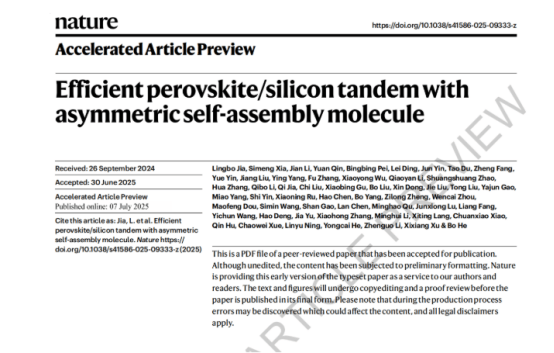
In recent years, crystalline silicon-perovskite tandem solar cells have developed rapidly, but the cells suffer from significant interfacial non-radiative recombination issues. Addressing the interfacial recombination caused by hole transport layers, the LONGi Green Energy team, in collaboration with Soochow University, has made breakthrough progress in the design of novel organic self-assembled monolayer (SAM) materials and in crystalline silicon-perovskite tandem devices. The related research results were published online on July 7 in the international academic journal Nature.
It is reported that in the photovoltaic field, interfacial non-radiative recombination affects device efficiency, and suppressing non-radiative recombination has been proven to improve device performance.
According to the head of the R&D team at LONGi Green Energy, the researchers proposed an asymmetric-structured self-assembled molecule (HTL201) as the hole-selective layer for wide-bandgap perovskite sub-cells. The strong interaction between HTL201 and perovskite promotes the deposition of high-quality perovskite thin films, significantly reducing the level of surface and interfacial non-radiative recombination. Building on the above research, the crystalline silicon-perovskite tandem solar cell developed by the team achieved an open-circuit voltage (the potential difference between the positive and negative electrodes when no current flows) approaching 2.0V and a certified efficiency of up to 34.6%. This research also provides an important technical solution for the development of new materials and for further improving the efficiency of crystalline silicon-perovskite tandem cells.
Previously, the LONGi Green Energy R&D team achieved multiple results in crystalline silicon-perovskite tandem solar cells. In September 2024, a paper published by the team in Nature showed that they had raised the efficiency of crystalline silicon-perovskite tandem cells to 33.9%, marking the first experimental demonstration that double-junction tandem solar cell efficiency exceeds the single-junction Shockley-Queisser (S-Q) theoretical efficiency limit—a milestone achievement.
It is known that for single-junction photovoltaic devices, regardless of the material used, the energy conversion efficiency cannot exceed 33.7%, which is the most commonly used and classic efficiency limit in semiconductors—the Shockley-Queisser limit (S-Q limit).
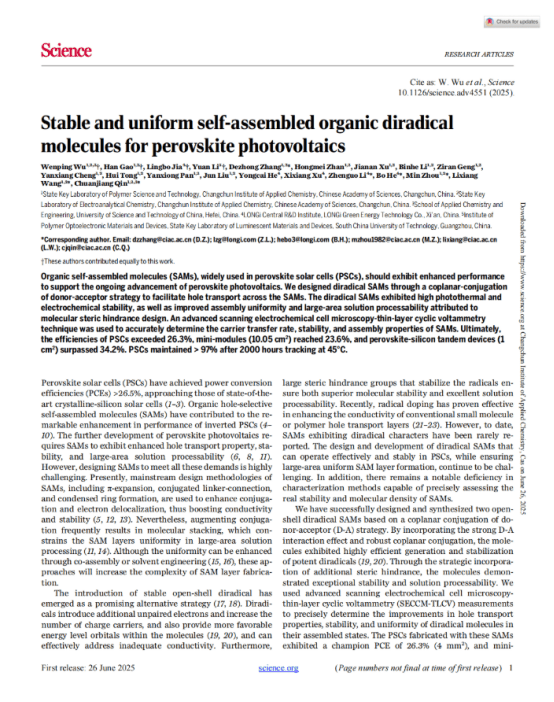
In addition, LONGi Green Energy, in collaboration with research teams including the Changchun Institute of Applied Chemistry of the Chinese Academy of Sciences, successfully developed a novel organic self-assembled molecule. This molecule exhibits excellent carrier transport capability, structural stability under real-world conditions, and outstanding assembly uniformity, leading to significant progress in both efficiency and stability of perovskite solar cells based on this material. The related research results were published on June 26 this year in the international academic journal Science.
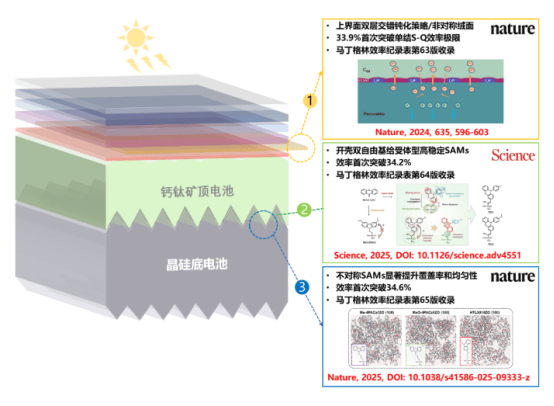
The head of the LONGi Green Energy R&D team stated that by publishing three academic papers, the team has openly disclosed to the entire industry the three world-record efficiencies of 33.9%, 34.2%, and 34.6% achieved by the team, which have been included in the 63rd, 64th, and 65th editions of Martin Green's World Record Efficiency Tables, respectively. It is reported that LONGi Green Energy, in collaboration with academic institutions such as Soochow University and the Changchun Institute of Applied Chemistry, has carried out industry-academia collaborative innovation to tackle major key challenges, contributing to the establishment of a healthy “industry-academia-research-application” ecosystem for tandem solar cells in China.