
The Ningbo Institute of Materials Technology and Engineering (NIMTE) of the Chinese Academy of Sciences has made significant progress in the field of spintronics by successfully transforming material defects—traditionally viewed as obstacles—into an advantage for quantum enhancement. The research results were recently published in the journal , providing new ideas for developing ultra-low-power spintronic devices.
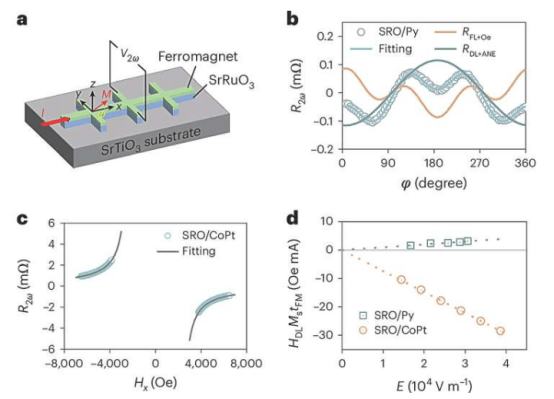
The research team focused on the orbital Hall effect in strontium ruthenate (SrRuO₃) materials and discovered that by precisely controlling material defects, both the orbital Hall conductivity and the orbital Hall angle can be simultaneously improved. Dr. Zheng Xuan, co-first author of the paper, stated: "The scattering processes that usually impair performance here actually prolong the lifetime of orbital angular momentum, enhancing the orbital current." This finding breaks through the long-standing dilemma in traditional spintronic device design where defects and performance are mutually restrictive.
Experimental data show that devices using the new method achieve a three-fold improvement in switching energy efficiency. Team leader Professor Wang Zhiming pointed out: "This research rewrites the design rules—we no longer need to avoid defects but can actively utilize them." The technology holds promise for application in next-generation memory, sensors, and logic devices, driving spintronics toward even lower power consumption.
The study verified unconventional quantum-scale laws through a customized measurement system and established connections with orbital relaxation mechanisms. This achievement not only deepens the understanding of orbital transport mechanisms in quantum materials but also provides an innovative path for the development of energy-saving electronic devices.