
A new study from the University of St Andrews suggests that particle temperatures in solar flares are 6.5 times higher than previously thought. The research provides an unexpected answer to a 50-year-old puzzle in stellar physics.
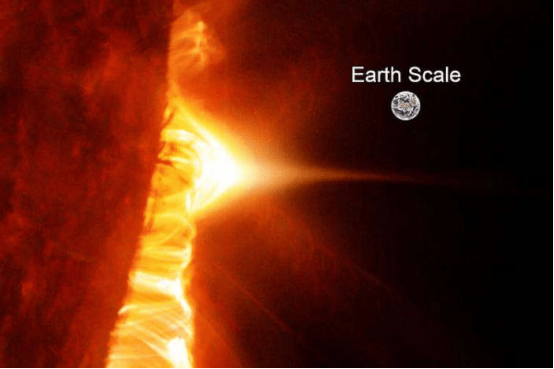
Solar flares involve sudden releases of enormous energy in the Sun's outer atmosphere, heating parts of it to over 10 million degrees Fahrenheit (about 10 million degrees Celsius). These violent events significantly increase solar X-rays and radiation reaching Earth, posing threats to spacecraft and astronauts while also affecting Earth's upper atmosphere.
Published in The Astrophysical Journal Letters, the study examines evidence of how solar flares heat plasma to over 10 million degrees Celsius. Solar plasma consists of ions and electrons. The new research indicates that ions in solar flares (the positively charged particles making up half of the plasma) can reach temperatures above 60 million degrees Celsius.
By examining data from other research fields, a team led by Dr. Alexander Russell, Senior Lecturer in Solar Theory at the School of Mathematics and Statistics, realized that solar flares likely heat ions much more strongly than electrons.
Dr. Russell said: “We are excited by the recent finding that the magnetic reconnection process heats ions 6.5 times more than electrons. This appears to be a universal law, confirmed in near-Earth space, the solar wind, and computer simulations. Yet no one had previously connected these findings from other fields to solar flares.”
“Solar physics has traditionally assumed that ions and electrons must have the same temperature. However, by recalculating with modern data, we found that in significant parts of solar flares, the temperature difference between ions and electrons can persist for tens of minutes, opening the door for the first time to considering super-hot ions.”
“More importantly, the new ion temperatures match the widths of flare spectral lines very well, potentially resolving an astrophysical mystery that has persisted for nearly half a century.”
Since the 1970s, a persistent question has been: why are flare spectral lines (bright enhancements in specific “colors” of solar radiation in extreme ultraviolet and X-rays) broader than expected. Historically, this was attributed solely to turbulent motions, but as scientists tried to characterize the nature of this turbulence, that explanation came under pressure.
After nearly 50 years, this new research advocates a paradigm shift: ion temperatures can make a major contribution to explaining the mysterious line widths in solar flare spectra.