
When Mars rovers like the 2009 "Spirit" became stuck, engineers on Earth had to carefully plan rescue operations—a process that is both delicate and time-consuming. To prevent similar crises in future planetary exploration, mechanical engineers at the University of Wisconsin-Madison used computer simulations to uncover a key flaw in Earth-based testing of Mars rovers. This discovery corrects overly optimistic expectations about rover performance in low-gravity environments.
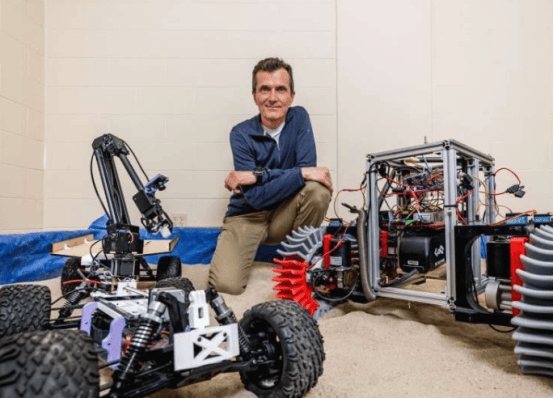
Accurately understanding a rover's mobility in low-gravity conditions is critical to preventing it from getting trapped in soft terrain or rocky areas. Traditionally, researchers test lightweight prototype rovers in desert environments to simulate lunar or Martian conditions. However, Professor Dan Negrut and his team at the University of Wisconsin-Madison found that the influence of Earth's gravity on sand was overlooked. On Earth, sand is compacted and provides stronger support due to gravity, whereas lunar and Martian sand is much looser, directly affecting the rover's traction and mobility.
“We need to consider gravity's effect on both the rover and the terrain,” said Professor Negrut. “Physics-based simulation is essential for analyzing rover mobility on granular soils.” The team detailed their findings in the Journal of Field Robotics. These discoveries stem from their participation in NASA's VIPER lunar rover simulation project. Using the open-source physics simulation engine Project Chrono, the team was able to rapidly and accurately simulate complex mechanical systems, including full-scale lunar rovers driving on “wet, soft” sand.
While simulating the VIPER lunar rover, the team noticed discrepancies between ground test results and lunar mobility simulations, ultimately revealing the testing flaw. The Chrono simulation engine not only supports space exploration but also has broad applications on Earth, from precision mechanical watches to off-road performance analysis of U.S. Army trucks and tanks.
“Our research has significant implications for solving real-world engineering challenges,” Professor Negrut said proudly. Although Chrono is free open-source software and faces challenges in competing with industrial-grade software, the University of Wisconsin-Madison team continues to invest in and innovate to enhance its features, maintaining its leading position.