
Scientists at Nanyang Technological University (NTU Singapore) have successfully built the world's first automated production line for robotic insects, bringing a revolutionary breakthrough to search and rescue operations in disaster areas. This innovative system, led by Professor Hirotaka Sato from the School of Mechanical and Aerospace Engineering, can automatically install tiny electronic backpacks onto the backs of Madagascar hissing cockroaches, transforming them into insect-hybrid robots.
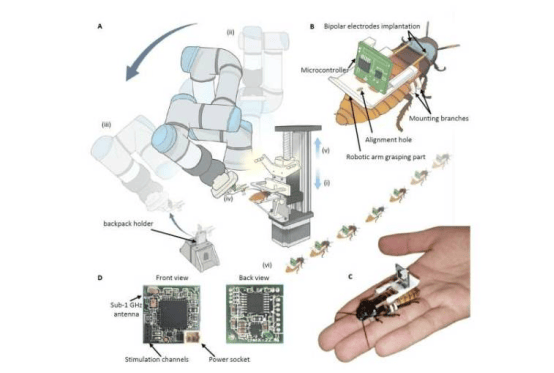
The automated system completes the installation of an electronic "backpack" in just 1 minute and 8 seconds, approximately 60 times faster than the traditional manual process, and handling four insects takes only 8 minutes, representing a significant efficiency improvement. Professor Sato stated that this innovation makes the dream of large-scale deployment of robotic insects much more realistic, which is critically important for time-sensitive operations such as post-disaster search and rescue.
Robotic insects not only possess the functions of traditional robots but can also move as flexibly as real insects and are guided through mild electrical stimulation delivered via implanted electrodes. The system utilizes computer vision and proprietary algorithms to precisely identify the optimal positions for implanting electrodes on the cockroach's back, ensuring accurate placement of the electronic backpack. At the same time, the voltage of the new-generation backpack has been reduced by 25%, extending operational time and reducing the risk of over-stimulation.
Laboratory tests show that the hybrid insects can perform sharp turns of more than 70 degrees according to commands, reduce speed by up to 68%, and demonstrate excellent navigation capabilities in test areas filled with obstacles. Although the assembly line is still in the prototype stage, robotic insects equipped with first-generation backpacks installed manually have already been deployed in the real world.
On March 30, 2025, a team of 10 robotic insects was dispatched together with the Singapore Civil Defence Force (SCDF) to Myanmar to participate in the "Lion Heart Operation" humanitarian aid mission in response to the devastating 7.7-magnitude earthquake that occurred on March 28. This marks the first time robotic insects have been used in humanitarian operations and the first field deployment of insect-hybrid robots, with on-site performance demonstrating their tremendous potential for locating survivors in disaster-stricken areas.
Professor Sato has received international recognition for his pioneering research in robotic insects. His achievements were selected by TIME magazine as one of the "50 Best Inventions of the Year" and by MIT Technology Review as one of the "10 Breakthrough Technologies." Looking ahead, Professor Sato's team will continue to improve the assembly system and collaborate with local partners to further validate its effectiveness and readiness for industrial applications, paving the way for more reliable robotic solutions.