
For millions of Americans with limited mobility, everyday tasks like making pizza are far more challenging than simply choosing ingredients. Good news from Virginia Tech researchers: they have developed a robotic arm equipped with a new assistive gripper that can help people with disabilities complete complex daily tasks, including making pizza. The research results were published in the journal Soft Robotics, aiming to enhance the independence of people with limited mobility.
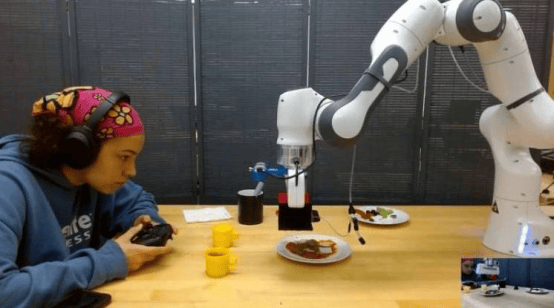
Associate Professor of Mechanical Engineering Dylan Losey and Michael Bartlett led the development. They are committed to creating new tools that can mimic the actions of human users. Losey said: "If we want to provide assistive robots for people, they need to fit the way humans perform tasks, making the robot's actions an extension of natural human movements, and the system must be user-friendly and intuitive."
With funding support of over $600,000 and the assistance of graduate researchers such as Maya Keely and Yeunhee Kim, the team successfully invented the new gripper. This gripper has outstanding capabilities and can grasp and move objects of various sizes, from a grain of sand to a large pot of water, and pizza ingredients are no problem either.
Robotic technology has great potential in helping people with disabilities complete daily tasks and improving independence, but performing a variety of tasks is not easy, especially when it comes to making dinner. There are many types of food with vastly different sizes, shapes, and textures. Even if the same robot can open a sauce jar, it may still have difficulty sprinkling shredded cheese.
In the recent study, the team programmed the robot to receive commands through a joystick similar to those used in video games, and used artificial intelligence to interpret the commands, understand human intentions, and then complete the remaining tasks. The team first started with a fun attempt at making an ice cream sundae, but the first attempt did not go smoothly. Losey explained that traditional robot grasping methods are not effective when picking up small items such as sprinkles and marshmallows. The problem was partly due to the material of the robot's gripper. Pure soft-material grippers have difficulty grasping irregular or heavier objects, while hard-material grippers cannot grasp small or grouped items.
To address this, Losey and Bartlett's team combined rigid robotics with flexible grippers, utilizing Bartlett's research achievements in soft materials and unique adhesives to develop "switchable adhesive" technology. Bartlett said that this adhesive can firmly attach to objects and release them at any time. The team designed soft bubble-like fingertips for the robotic hand, which deflate to form adhesion when contacting objects and inflate to release the adhesion. With the help of switchable adhesive, the robot successfully made an ice cream sundae sprinkled with sugar crumbs.
Pizza became the team's next challenge. Bartlett said that having the robotic arm collaborate with humans to make pizza is a test for all aspects of the system. Pizza crusts and cheese vary in size, sauces and toppings have different textures, and everyone's pizza topping needs are personalized. This requires close coordination between humans and the robot, with the robot using its learned knowledge to make the pizza that the operator wants. In the end, under human instructions, the robot hand picked up a hard metal pizza pan, spread out the soft pizza dough, sprinkled sauce, Italian sausage, chili peppers, olives, and cheese. The sticky fingertips helped it successfully complete the pizza making.
This cooking achievement highlights the core goal funded by the National Science Foundation — to fundamentally advance robotics technology so that people with disabilities can perform a wider range of tasks. Losey said that in the long term, the team hopes to create a robot that can pick up any object, regardless of whether it is soft or hard, large or small, or what material it is made of. If the robot can help with daily tasks such as making lunch or an ice cream sundae, it will greatly improve the lives of people with disabilities.