
On August 16, reporters learned from China Railway Fourth Engineering Group that the first intelligent mobile cap beam trolley in China has successfully completed the pouring of its first cap beam at the construction site of the Yintian Viaduct on the Shenzhen Outer Ring Expressway Phase III (Kengzi to Dapeng Section) Project 2, which is undertaken by the group.
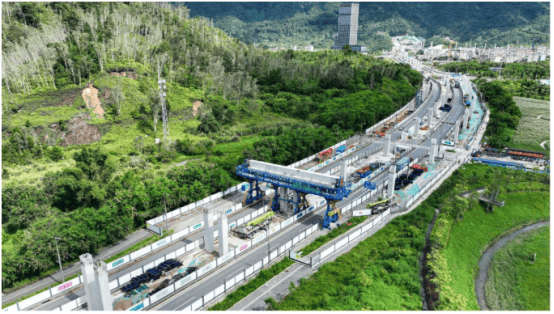
The Shenzhen Outer Ring Expressway Phase III project has a total length of 16.81 kilometers, with the section under China Railway Fourth Engineering Group spanning 2.462 kilometers. The construction scope includes bridges, subgrades, greening, and relocation of municipal pipelines. The project involves the construction of 133 cap beams, including 23 large cantilever cap beams and 110 portal pier cap beams.
"The project construction area is located in a densely populated residential and industrial zone in Shenzhen, with complex traffic networks. Working on a two-way four-lane highway, traditional cap beam construction methods would make it difficult to meet expected targets for schedule control and safety management," said Zhu Jiahuan, project manager of China Railway Fourth Engineering Group. After multiple on-site inspections, technical research, and expert demonstrations, the project team developed and applied the intelligent mobile cap beam trolley known as the "Aerial Cap Beam Vehicle" to provide new momentum for high-quality project construction through "intelligent construction."
The trolley weighs 120 tons, is 10.3 meters wide and 10.8 meters high, and moves at a speed of 3 meters per minute. It consists of systems including walking, jacking, translation, load-bearing foundation conversion, main portal frame components, transverse connection systems, prefabricated protection, and intelligent maintenance. Through Internet of Things (IoT) technology, it achieves intelligent collaborative operation of all systems, effectively solving problems of traditional cap beam construction such as low precision, long formwork disassembly and assembly cycles, inflexibility, and large space occupation.
To ensure construction safety over the existing highway, the upper working surface of the trolley adopts a "full patterned steel plate covering + prefabricated protection platform" design, achieving complete isolation between the construction site and the existing road, eliminating the risk of falling objects at the source. Its support system is a rigid integrated structure that forms a stable force-bearing framework through transverse connections and diagonal braces, providing strong overall anti-overturning capability. At the same time, the trolley has a high degree of prefabrication, abandoning traditional welding processes. All components are connected by full bolts. After assembly in the yard, it can be lifted into place across the road in one go. Once put into use, it can reduce road-crossing lifting operations by more than 1,000 times, effectively lowering lifting risks. In addition, the trolley is equipped with sensors that can detect terrain settlement, foundation displacement, and other data in the construction area. Relying on AI algorithm tools and big data analysis platforms, it automatically generates adjustment plans, corrects displacement deviations, and optimizes support forces.
"The trolley moves between two cap beam positions, positions itself, and performs fine adjustment, completing the entire process in just half an hour," said Chen Lei, chief engineer of the project department of China Railway Fourth Engineering Group. The structural design of the trolley follows the principle of "minimalism and high efficiency," eliminating the cumbersome steps of repeatedly disassembling and assembling formwork and recalibrating positioning in traditional construction, thereby shortening the time for cross-position operations. At the same time, the intelligent operating system realizes automated control of the work process. Operators can control the trolley's movement with a single button on the console, reducing operational risks and improving construction efficiency.