
A Korean research team has developed a new hydrogel pore control technology that achieves precise regulation of material deformation through an origami-inspired folding mechanism. The study was led by Professor Hyunsik Yoon from Seoul National University of Science and Technology, with team members including Dr. Jihoon Kim and Professor Woobo Lee. The research results have been published in the journal Matter.
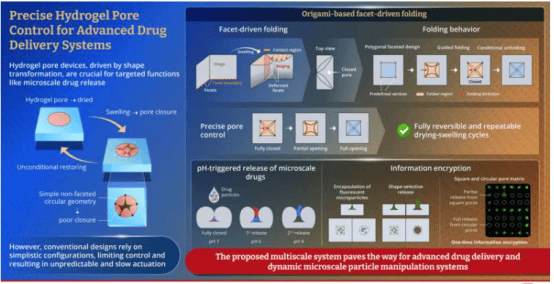
Traditional hydrogel materials use circular pore designs, which suffer from low deformation control precision, slow response speed, and insufficient recovery performance. The research team innovatively incorporated the hinge and facet structure principles of origami art into the design of polygonal hydrogel pores, achieving programmable deformation control. Professor Yoon said: "Unlike traditional circular pores that lead to random folding, our design involves a facet-driven folding strategy that integrates origami-inspired hinges and facets into polygonal hydrogel pores to achieve programmable and predictable actuation."
This technology guides the pores to close in a specific direction during expansion and recover to their original shape along the same path during contraction by presetting the boundaries and hinge positions of the polygonal pores. Experiments show that the polygonal pores can still maintain more than 90% of their original shape after multiple expansion-contraction cycles, demonstrating significantly improved reliability. By adjusting the polygonal geometric parameters, the researchers can also precisely control the degree of pore closure.
In terms of applications, the team developed a pH-triggered hydrogel system capable of releasing particles in stages. Professor Woobo Lee pointed out: "This pH-responsive mechanism is very useful for drug delivery applications, as drug release occurs in stages and targets specific areas marked by pH fluctuations." In addition, the study also demonstrated the technology's potential in the field of information encryption, achieving pattern hiding and display functions through a matrix of mixed pores with different shapes.
Dr. Jihoon Kim said: "Our strategy can be integrated into drug delivery systems to achieve high spatial and temporal precision, improve therapeutic effects, and minimize side effects. This design opens new opportunities for advanced lab-on-a-chip systems, next-generation soft robotics components, and diagnostic detection."