
In the field of green manufacturing, solar cell technology has always been a major focus. Perovskite semiconductors, as a new type of material for solar cells, offer the advantages of being ultra-thin and flexible, simple to manufacture, low-cost, and extremely high efficiency. However, for perovskite solar cells to achieve large-scale commercialization, they face two major challenges: poor long-term stability over decades, and the toxicity issues associated with high-performance lead-containing perovskite materials.
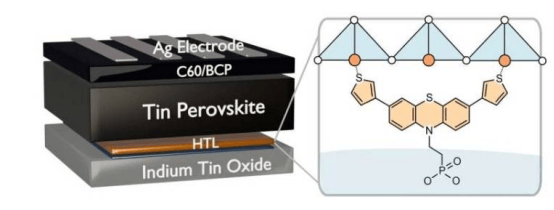
Against this background, tin perovskite solar cells being researched by HZB have emerged as an interesting and non-toxic alternative. Their stability may surpass that of lead-based solar cells, and due to their special optoelectronic properties, they are particularly suitable for use in tandem and triple-junction solar cells. However, tin perovskite solar cells still lag behind lead-based perovskites in terms of achieving high efficiency.
Currently, the bottom contact layer of tin perovskite solar cells is mostly prepared using PEDOT:PSS. This process is not only cumbersome but also causes losses. In lead perovskites, the PEDOT:PSS layer can be replaced by a self-assembled monolayer (SAM), which has even set new efficiency records. However, previous experiments with SAMs based on the MeO-2PACz compound in tin perovskites performed worse than PEDOT:PSS.
Dr. Artem Musiienko, the lead researcher, and his partners conducted an in-depth analysis of the potential issues when using MeO-2PACz as the contact layer for tin perovskites. Through density functional theory calculations, they found that the interface created resulted in non-uniform alignment with the adjacent perovskite lattice, leading to significant losses. The related study was published in the journal Advanced Energy Materials.
To solve this problem, the research team began searching for more suitable self-assembled monolayer (SAM) molecules. They identified phenothiazine containing a sulfur functional group (abbreviated as Th-2EPT), which was synthesized by Dr. Tadas Malinauskas and Mantas Marčinskas from Kaunas University of Technology in Lithuania.
Experiments showed that, compared with PEDOT, Th-2EPT can form perovskite thin films with comparable crystallinity, although with smaller grain sizes. Tin perovskite solar cells fabricated with Th-2EPT SAM outperformed the control cells made with PEDOT or MeO-2PACz. It forms an excellent interface that minimizes recombination losses.
Artem Musiienko stated: "We have demonstrated that through targeted and rational molecular design, the performance of tin perovskite photovoltaic cells can be significantly improved." The new tin perovskite solar cells using Th-2EPT achieved an efficiency of 8.2%. These results lay the foundation for further improvement of tin perovskite interfaces and pave the way for the development of pure tin perovskite tandem solar cells. Valerio Stacchini, one of the first authors of the paper, said: "We have proven that the higher performance originates from the superior optoelectronic quality of the perovskite grown on the new SAM."