
Japanese researchers have successfully synthesized a new van der Waals oxide, 2H-NbO₂, which exhibits electronic properties highly relevant to two-dimensional flexibility. The study was led by Assistant Professor Takuto Soma, Associate Professor Kohei Yoshimatsu, Professor Akira Ohtomo, and graduate student Aya Sato from the Tokyo Institute of Science, in collaboration with Professor Hiroshi Kumigashira from Tohoku University.
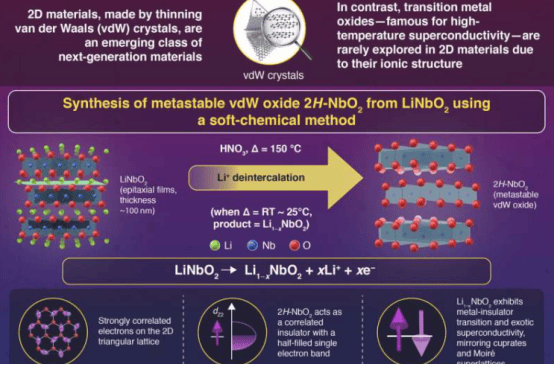
The research team chemically extracted lithium ions from layered LiNbO₂ thin films, converting the three-dimensional oxide into a two-dimensional material and thereby unlocking unique properties such as a Mott insulating state and superconductivity. This discovery bridges the fields of transition metal oxides and two-dimensional materials, offering a new pathway for realizing advanced quantum materials in next-generation electronic devices.
Two-dimensional materials have become a cornerstone of next-generation electronics research. Their layers are held together by weak van der Waals forces, giving them unique quantum properties and application potential. However, transition metal oxides have remained largely unexplored in two-dimensional applications due to their inherent strong ionic bonding characteristics.
Soma emphasized: "By synthesizing 2H-NbO₂, we have obtained a strongly correlated van der Waals oxide that combines the characteristics of both transition metal oxides and two-dimensional materials." The team employed a unique chemical strategy using nanoscale LiNbO₂ thin films and achieved selective removal of lithium ions through a high-temperature strong oxidation reaction, resulting in a 2H-type layered structure with a hexagonal honeycomb pattern.
Advanced analysis of 2H-NbO₂ confirmed that the material is a correlated insulator, primarily due to its half-filled single-electron band structure. This electronic structure leads to strong electron-electron repulsion, resulting in insulating behavior even in the presence of Nb 4d electrons. During partial lithium deintercalation, the researchers observed strongly correlated system characteristics such as metal-insulator transitions, superconductivity, and non-Fermi liquid behavior.
Soma explained: "The significance lies in connecting two research fields that have developed independently until now — correlated oxides and two-dimensional materials. Our discovery reveals a new type of two-dimensional quantum material that combines strong electronic correlations with the structural flexibility of van der Waals compounds."
The research results have been published in the journal ACS Nano and are expected to find wide applications in quantum materials, next-generation electronic devices, and sustainable materials science. This breakthrough provides new synthetic ideas for developing novel two-dimensional materials with distinctive electronic properties.