
Nonlinear optical dynamics, which exhibit light-intensity-dependent responses under high-intensity light sources, hold significant importance and wide applications in modern photonics. These include lasers, amplifiers, modulators, sensors, and quantum optics, among others. In recent years, nonlinear optical effects have made progress in applications based on microresonator optical frequency combs, laying the foundation for advancements in multiple fields. At the same time, researchers have also achieved substantial results in the study of interactions between free electrons and light in electron microscopes, where photonic structures play a crucial role in modulating these interactions.
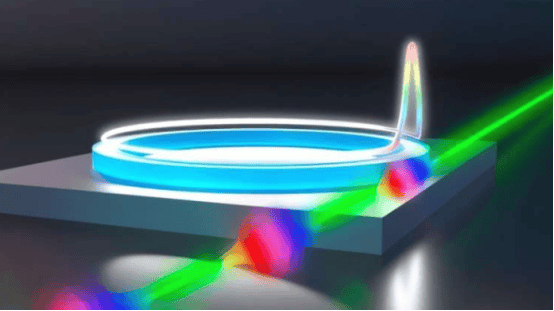
However, previous research on high-quality-factor on-chip optical microresonators has mostly utilized the linear response of the cavities, overlooking their rich nonlinear optical dynamics. An international research team led by Dr. Yujia Yang from the Swiss Federal Institute of Technology Lausanne (EPFL), Professor Tobias J. Kippenberg, and Professor Claus Ropers from the Max Planck Institute for Multidisciplinary Sciences in Germany has comprehensively summarized the latest advances in electron-photon interactions in electron microscopy in 2024 in a review article. They particularly highlighted groundbreaking work on coupling free electrons with nonlinear optical states in integrated photonic microresonators.
Dr. Yang stated: "We used transmission electron microscopy to couple free electron beams with various spatiotemporal optical waveforms and demonstrated ultrafast electron beam modulation using on-chip femtosecond time solitons." In addition, the team summarized other promising developments, such as the realization of attosecond electron microscopy. Professor Kippenberg noted that the rich nonlinear optical dynamics of high-quality-factor microresonators offer opportunities to control free electrons and probe nonlinear optics. Professor Ropers predicted that these developments will promote innovative research and applications across multiple fields and emphasized the potential of the 2024 breakthroughs in photonics.