
Since 2024, the State Administration for Market Regulation (SAMR) has launched a two-year special campaign to "strengthen the quality chain of power batteries." To date, multiple national standards have been approved and released. By building a full lifecycle standards system, new momentum is being injected into the high-quality development of the new energy vehicle industry.
In this special campaign, SAMR organized the compilation of the "Standards System for Power Battery Safety and Quality Improvement," covering six major sectors including basic general requirements, materials and components, and manufacturing and testing, achieving full coverage from the "laboratory" to the "road."
Tao Liang, Deputy Director of the Standards Application Management Division, Standards Innovation Management Department, SAMR: For example, the series of national standards for lithium-ion battery production quality management anchors the control framework from the top-level overall requirements, extending downwards to raw material incoming inspection, cell单体 manufacturing, finished product testing, battery pack integration, and product verification, achieving full-process quality closed-loop management at the production end.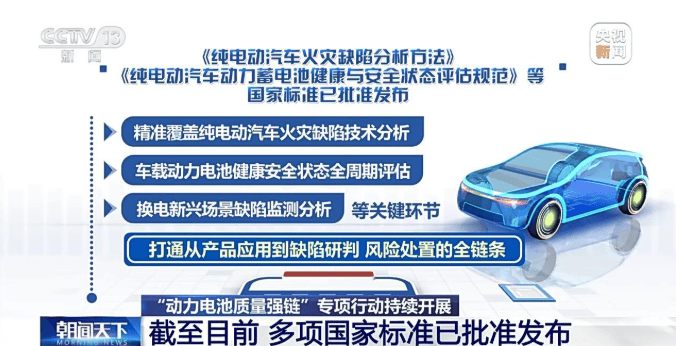
To date, national standards such as "Analysis Methods for Fire Defects in Battery Electric Vehicles" and "Specification for Health and Safety Status Assessment of Traction Battery for Battery Electric Vehicles" have been approved and released.
These standards precisely cover key links such as technical analysis of fire defects in battery electric vehicles, full-cycle assessment of onboard power battery health and safety status, and defect monitoring and analysis in emerging battery swap scenarios, connecting the entire chain from product application to defect diagnosis and risk disposal. In addition, four other standards related to production quality management have entered the project initiation and approval stage.
Technical Specification for Power Battery
Defect Investigation and Recall Implementation Released
How to accurately determine safety hazards in new energy vehicle fire accidents is a major concern for consumers. In this quality chain strengthening special campaign, SAMR has further enhanced the scientific nature of power battery defect investigation and recall through innovative technical means.
Xiao Lingyun, Director of the Industrial Products Division, SAMR Defective Product Administrative Center: The power battery quality chain strengthening project conducted in-depth research on key technologies such as in-depth fire accident investigation, power battery safety early warning, and thermal runaway defect determination, establishing the industry's first power battery quality safety map and a library of hazardous fire scenarios for new energy vehicles. The application of these results has further improved the ability to accurately determine the causes of new energy vehicle fires and rapidly identify safety defects.
Based on this, China has formulated and released the first "Technical Specification for Power Battery Defect Investigation and Recall Implementation."
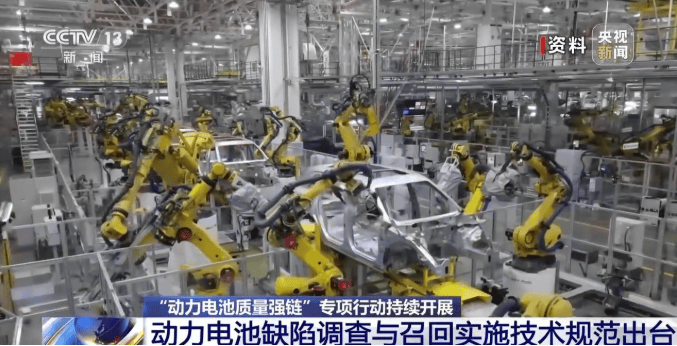
It is understood that, relying on the research results of the quality chain strengthening special campaign, SAMR has completed investigations into over 80 power battery fire accidents, supported defect analysis for 10 vehicle models, and promoted enterprises to implement recall rectifications, effectively safeguarding consumers' personal and property safety while also helping enterprises eliminate safety hazards in a timely manner.
Power Battery Testing Equipment
Reaches International Advanced Level
Furthermore, the reporter learned that in the research, development, and evaluation of first-of-a-kind equipment, the power battery quality chain strengthening special campaign successfully completed the testing and evaluation of ultra-fast online CT for power batteries and automated cell performance testing equipment. Multiple indicators have reached the international advanced level.
Tao Liang: The ultra-fast online CT equipment has broken through the efficiency bottleneck of traditional equipment. Through multiple independently innovative technologies, the single cell scanning cycle has been compressed from the original 15 minutes to just 5 seconds, increasing efficiency by over a hundredfold. To date, this equipment has completed the testing of more than 14,000 cells, and its core technology has reached the international advanced level.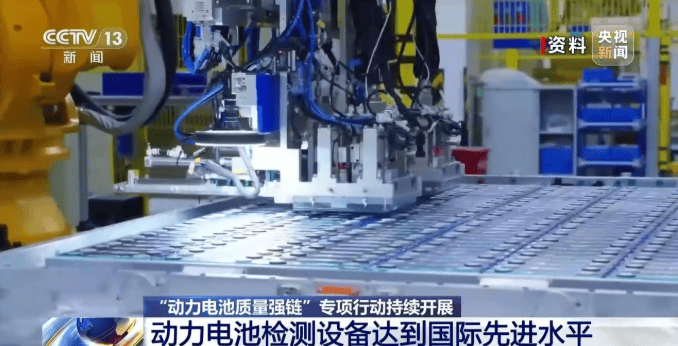
The simultaneously unveiled automated cell performance testing equipment is also impressive. This equipment can reduce manpower requirements by 85%, with a testing efficiency rate of 95%. Currently, the relevant enterprise has built the world's first large-scale unmanned power battery testing laboratory, with an annual testing capacity of 100,000 cells, and is compatible with the vast majority of mainstream products on the market, providing a solid quality infrastructure support for China's new energy vehicles to lead the global race.