
Researchers at the Swiss Federal Laboratories for Materials Science and Technology have combined ultra-high-performance fiber-reinforced concrete with iron-based shape-memory alloy rebars to create a strengthening layer that can actively prestress existing bridge decks, offering a new solution for repairing aging bridges worldwide.
In the United States, data from the Federal Highway Administration shows tens of thousands of bridges classified as structurally deficient, and several European countries face similar aging infrastructure problems. Direct bridge replacement is costly and disruptive, leading the industry to shift toward life-extension strategies. Traditional strengthening methods rely on external post-tensioning, steel plates, or fiber-reinforced polymer laminates, often requiring complex anchoring hardware and significant installation time.
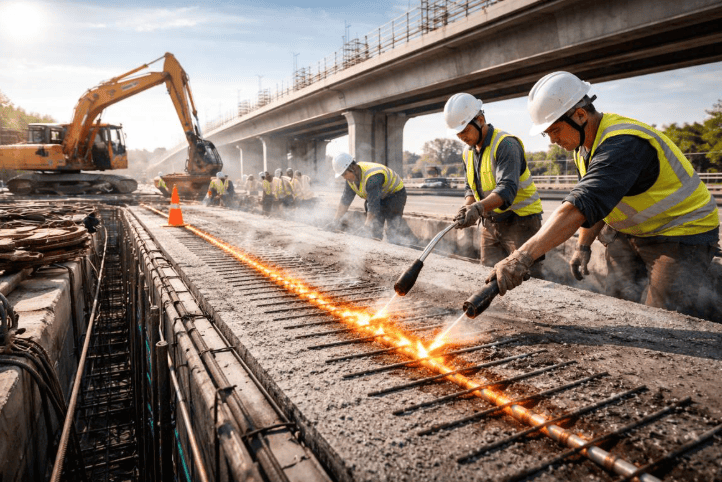
The Swiss research team's innovation lies in replacing conventional reinforcement within the overlay with shape-memory alloy rebars. These rebars are installed in a pre-stretched state and, when heated to approximately 200°C, the alloy attempts to return to its original shape. Because it is anchored within the concrete and cannot contract freely, compressive stress is generated within the structure, introducing prestress without the use of hydraulic jacks or tensioning systems. The iron-based shape-memory alloy contains elements such as manganese, silicon, and chromium; heating triggers its recovery to the original configuration. The compressive stress is transferred to the surrounding material through the anchorage zones, capable of closing cracks and slightly lifting sagging members.
The research team conducted full-scale experiments using five-meter-long concrete slabs representing cantilever bridge deck sections. These slabs were intentionally cracked before strengthening to simulate actual bridge deterioration. After installation, the shape-memory rebars were activated by heating, and observers recorded immediate crack closure and the disappearance of residual deformation. The team monitored structural behavior using optical crack-tracking cameras and fiber-optic sensors embedded along the rebars. Researcher Christoph Czaderski explained: "The sensors we use work on a principle similar to fiber-optic cables in telecommunications. Instead of sending coded data through the fiber, we analyze the backscattered light, which allows us to see precisely how the rebar is deforming."
Compared to untreated specimens, the strengthened slabs demonstrated at least a twofold increase in load-bearing capacity. Slabs reinforced with shape-memory rebars exhibited greater stiffness, smaller permanent deformations, and better crack control under repeated loading cycles. Angela Sequeira Lemos, who led the study, stated: "We were able to demonstrate that our system is not only effective but can actually revitalize existing bridges." The project, funded by Innosuisse and developed in collaboration with the University of Applied Sciences of Eastern Switzerland, the spin-off company re-fer, and the Swiss Cement Industry Association, is currently seeking demonstration on a real bridge.