
Since 1987, when the former Shanghai Municipal Housing Construction Headquarters promoted water spray tests for high-rise residential buildings citywide, the words "rain" and "water" have always been the most sensitive line of defense for people's peace of mind in their homes. The intelligent high-pressure water spray robot, independently developed by Shanghai Construction No. 2 (Group) Co., Ltd. over many years, has filled a gap in the field of high-end equipment for fully automated leakage detection in China's construction industry. It has completely rewritten the traditional, crude method of manual water spray operations using "a broom and a water hose," establishing the "first line of defense" for the waterproofing safety of super high-rise building facades from the source, in a fully automatic, intelligent, and traceable manner.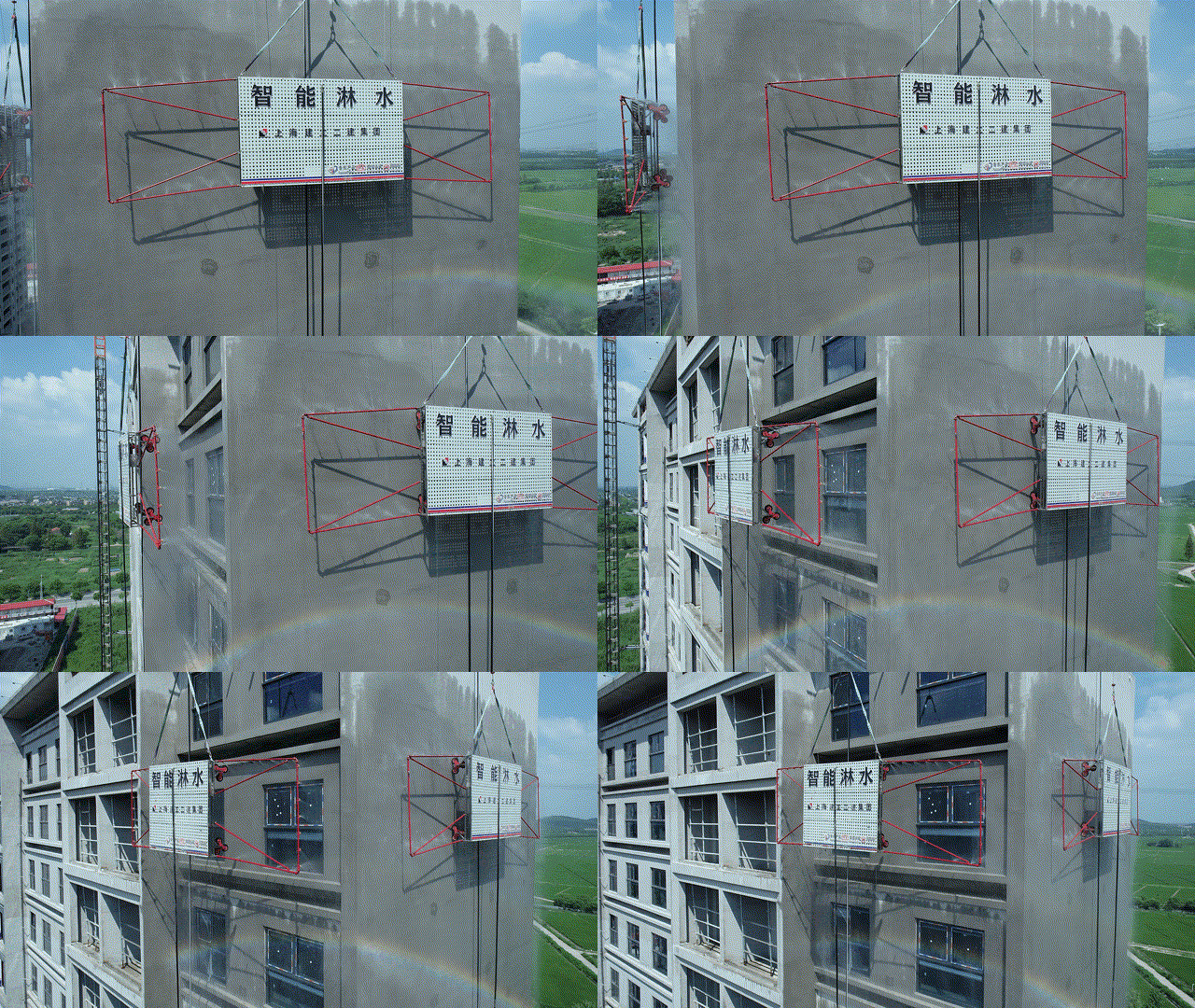
Cities Rise, Hidden Dangers Deepen: The "Old Pain Point" of Building Leakage
Over more than 40 years of China's urbanization, super high-rise buildings have continuously reshaped city skylines, while also posing entirely new challenges to building safety, operation, and maintenance. Leakage in external walls and windows, the most common quality defect in building engineering and the one that most troubles residents, has always been an extremely thorny pain point before and after property handover:
Conventional inspection methods have "inherent deficiencies": Traditional manual water spray tests use tap water sprayed upwards from the ground. The water pressure is too low, barely managing to "wet the wall surface," making it fundamentally impossible to effectively discover hidden leakage risks in weak spots like external wall panel joints and window frame sealant joints, let alone realistically simulate the actual conditions of external walls subjected to water during extreme weather like typhoons and rainstorms.
Extremely high risk in high-altitude operations: Manual external wall water spraying generally relies on workers suspended from gondolas or safety ropes hundreds of meters in the air to complete near-wall spraying operations. Not only is the safety risk difficult to control, but the water spray coverage is also small, often creating blind spots in critical areas such as gable walls, cantilevers, and corners.
Low detection efficiency and accuracy: Traditional water spray tests require 8 workers spending 7 to 10 days to complete the inspection cycle for a single building. During the operation, problems commonly arise, such as a lack of remote recording, vague marking of leakage locations, and the inability to retain image data. Data management and traceability capabilities seriously lag behind the requirements of project delivery standards.
From "Workers Carrying Hoses onto Gondolas" to "Intelligent Robot Autonomous Spraying"
The intelligent high-pressure water spray robot is completely independently developed by Shanghai Construction No. 2 (Group) Co., Ltd., representing a typical shift in the urban construction field from "experience-based craftsmanship" to "intelligent equipment."
This robot is based on a three-in-one integrated architecture comprising an intelligent spray control system, an intelligent perception lifting module, and a remote IoT monitoring platform, achieving full-process automation and intelligence in building external wall leakage detection.
1. Upgraded Coverage Capability — Typhoon-Level "Detection Power"
The robot's maximum water spray coverage width reaches 14 meters (8 meters at corners), with a vertical spray height of 3 meters. A single operating station can completely cover an external wall area of over 40 square meters in one go. The water outlet pressure range is 0.5–1.2 MPa, capable of simulating in real-time the true effect of high-intensity rainwater continuously impacting external walls under Level 12 typhoon and rainstorm conditions. Simultaneously, the robot can autonomously identify and climb over external wall structural obstacles such as ladders, large balconies, and decorative moldings, truly achieving fully adaptive operation for building facades of different architectural styles.
2. Highly Automated Full Process — Millisecond-Level Response to Remote Commands
The robot is underpinned by intelligent devices and smart IoT technology, operated remotely by backend technicians. It can instantly respond to various operational commands within 10 milliseconds. Operators at the ground terminal can adjust water pressure in real-time, monitor the spray range, and synchronously control the operation duration. Simultaneously, the system retains the positioning coordinates of leakage points, water seepage time, and on-site image data around the clock, and can generate standardized inspection reports with a single click.
3. Leap in Detection Efficiency — 4-6 People Complete Two 20-Story Buildings in 7 Days
Under the traditional model, 8 workers took 7–10 days to complete a full water spray inspection for one building. For an equivalent task volume, the current third-generation product application requires only 4–6 operating technicians to simultaneously complete high-quality water spray inspections for two 20-story high-rise buildings within 7 days. In the Nicheng 02 plot project, this system achieved outstanding operational results: exposing external door and window leaks within 0.5 hours, discovering deep external wall leaks within 1 hour, and breaking through a single-day inspection area of 960 square meters.
4. Industrialized Mass Production of Hardware Parameters — Full Adaptation to Multiple Scenarios
In the intelligent water spray equipment system, the climbing mechanical unit uses high-strength, lightweight aviation aluminum alloy material, effectively resisting high-altitude wind vibration interference. The intelligent spray valve group and pressure stabilization system ensure the stability of long-distance, high-altitude, high-pressure continuous water delivery. The cloud-based intelligent management platform uniformly dispatches remote commands, and performs real-time data storage and analysis, making inspection results traceable over the long term.
Already Served Over 1.3 Million Square Meters, Leading the Compilation of CECS National Standard
Since its official release in February 2024, this intelligent water spray robot has undergone multiple rounds of high-intensity engineering validation and iterative upgrades, completing over 160,000 square meters of pilot testing to date. As of now, the robot has successfully served over 90 projects, with a cumulative inspected area exceeding 1.3 million square meters, covering more than 30 major and key projects including Haiyue Huangpu Origin, the Sino-French Aviation University EPC project, and the Shanghai Biomedical Industry Base. It has become the most commercially successful equipment in Shanghai Construction Group's construction robot fleet.
In terms of key technology protection and standard leadership, this equipment has cumulatively applied for and been granted 14 patents (including 4 invention patents), and obtained multiple utility model patents and design patent authorizations. The CECS standard "Technical Standard for Intelligent Water Spray Test on Building External Walls," led by Shanghai Construction No. 2 (Group) Co., Ltd., has been officially submitted for review, marking the elevation of this innovative achievement from corporate practice to an industry-wide technical specification, providing standardized guidance for the large-scale promotion of intelligent inspection equipment in the construction industry.
Guarding the Lifeline of Megacities, Building an "Invisible Barrier" for Hundreds of Millions of Residents
1. A crucial tool for the long-term safety, operation, and maintenance of urban super high-rise buildings
China has a massive stock of super high-rise residential and commercial buildings, and demand for new construction remains strong. Structural leakage hazards in the facades of high-rise buildings are the most common and hardest-to-cure "chronic disease" in the long-term operation and maintenance management of urban facilities. The popularization of Shanghai Construction Group's intelligent water spray robot will provide city managers with an "ultimate assessment" method for the quality of newly delivered projects, and offer a new capability for regular safety reassessments of existing buildings, significantly reducing the economic and legal burdens of resident leakage complaints and subsequent repairs from the source.
2. A "Frontline Defense" for major emergencies and disaster prevention
This robot has already participated in the 2026 Yangtze River Delta International Emergency Disaster Reduction & Rescue Expo. One of its core positioning goals is to conduct large-scale leakage detection and hazard prediction for large public buildings and super high-rise residential clusters before major meteorological disasters (typhoons, rainstorms) strike, providing a systematic basis for disaster prevention and reinforcement, thereby minimizing secondary disasters caused by extreme weather, such as facade rainwater penetration, interior decoration damage, and even building envelope structural damage.
3. A scientific tool for urban renewal and old residential community renovation
As the nation deeply advances urban renewal actions, a large number of high-rise residential buildings constructed from the 1990s to the early 2000s urgently need facade renovation and anti-seepage reinforcement. The intelligent water spray robot's technical capability for autonomous, non-impact, flexible obstacle climbing allows for rapid and precise leakage detection without damaging old exterior finishing materials. This accelerates the waterproofing renovation and acceptance process for old residential communities, reduces waiting time for residents' secondary relocation, and greatly enhances the construction management efficiency of project developers and property management companies.
4. Leading a new paradigm of "Robot + Standard" in the construction industry
With the implementation and promotion of the CECS standard, professional intelligent water spray inspection will gradually replace outdated manual empirical methods, becoming the "first acceptance checkpoint" for external wall waterproofing in new construction and renovation delivery projects. The large-scale market application of this equipment will directly give rise to a brand-new industry data system of "water spray inspection archives" for the entire lifespan of urban buildings. This will drive the accumulation of data elements in the construction process and collaborative industry quality management, marking a historic leap in China's construction industry quality management from "manual visual inspection" to "intelligent equipment quality assessment."