
From 0.5 grams of lunar surface dust collected 380,000 kilometers away, scientists at Donghua University have spun delicate, hair-thin "space fibers" that combine flexibility and strength. On May 11, 2026, China's first lunar soil fiber experimental sample was launched aboard the Tianzhou-10 cargo spacecraft to the China Space Station, where it will face the harsh tests of high vacuum, intense radiation, and extreme temperature fluctuations on an external exposure platform. This achievement represents a decade of dedication by the team led by Academician Zhu Meifang of Donghua University and marks an original and pioneering contribution by China in the field of in-situ lunar resource utilization, providing critical material support for the construction of a lunar research station by 2035.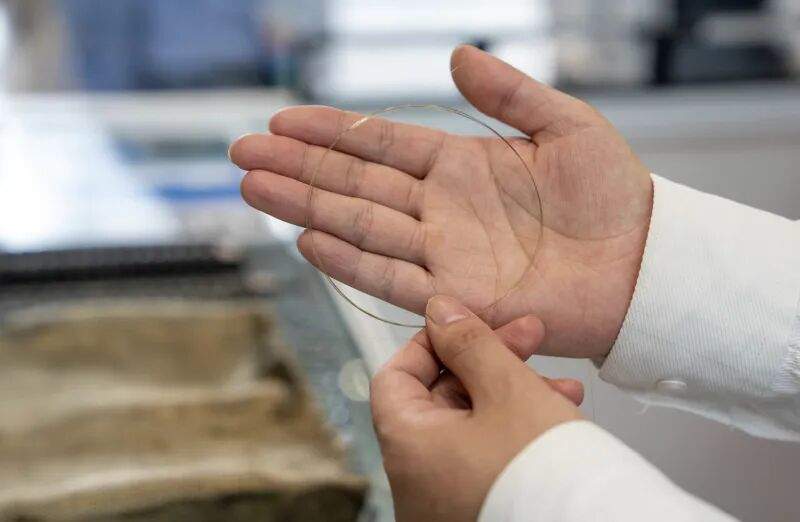
From "Candied Sweet Potato" to "Space Pulling": A Bionic Breakthrough
The breakthrough in spinning lunar soil into fibers was not an overnight miracle but the result of a decade-long relay race.
Looking back to 2016, Academician Zhu Meifang of the Chinese Academy of Sciences and the School of Materials Science and Engineering at Donghua University led a major basic research project commissioned by the Shanghai Municipal Science and Technology Commission. Her team started with research on nanomaterials and gradually turned their focus to extreme environment materials. "How extreme can extreme environments get? Why not aim for space?" This simple goal planted the seed for deep-space exploration.
The team likened lunar soil to "space granulated sugar," drawing inspiration from the melt-spinning principle used in making "candied sweet potatoes"—melting lunar soil into droplets at high temperatures and then precisely drawing them into fibers. However, the high vacuum and microgravity conditions on the Moon render all conventional equipment and processes on Earth completely ineffective. With no existing technology to reference, they started from scratch and independently designed the world's first spinning device that simulates the lunar environment.
Using 0.5 grams of lunar basaltic soil (a precious sample weathered by billions of years in space) brought back by the Chang'e-5 mission, the team successfully produced continuous fiber samples approximately 3 meters long and over a dozen micrometers in diameter—comparable to the thickness of a human hair—in a simulated lunar environment. This marked a historic leap from "theoretical possibility" to "engineering feasibility." On April 1, 2025, this "space fiber" was exhibited at the National Museum of China as part of the "Reaching for the Moon: 20 Years of China's Lunar Exploration Program" exhibition. In September of the same year, this core technology, with fully independent intellectual property rights, won the Grand Prize at the 25th China International Industry Fair.
Three Generations of Equipment Iteration: From Milligram-Level to Continuous Production
To transition lunar soil fibers from "laboratory success" to "engineering-ready usability," the team iteratively developed three generations of core equipment, achieving milestones such as fiber formation from milligram-level samples and continuous production in a high-vacuum environment. This "Modular Equipment for In-Situ Lunar Soil Fiber Preparation" uses lunar soil as the sole raw material, requires no additives, and can autonomously melt lunar soil powder at high temperatures under unmanned, high-vacuum, and microgravity conditions, then draw fibers using vacuum traction and high-speed spinning technology.
The chemical and mineral composition of lunar soil is similar to terrestrial basalt, and basalt fibers have long been widely used in high-end equipment manufacturing. The various trace elements present in lunar soil endow "space fibers" with unique composite functional potential. In a sense, this work seamlessly transfers the knowledge system of the chemical fiber industry, accumulated over decades on Earth, to the interstellar wilderness 380,000 kilometers away—not by building an Earth-like factory, but by creating an equipment system capable of "creating something from nothing" in extreme environments.
Strategic Significance of Space Station External Exposure Experiments
The cost of Earth-Moon transportation is extremely high, with launch costs per kilogram of payload amounting to tens of thousands of dollars. It is estimated that transporting one kilogram of material to the lunar surface costs millions of dollars. Therefore, the construction of future lunar research stations must rely on "using local materials"—In-Situ Resource Utilization (ISRU) is the only viable path for extraterrestrial construction.
The first Chinese lunar soil fiber experimental sample carried by the Tianzhou-10 cargo spacecraft represents a major leap: "originating from the Moon, processed on Earth, and returning to space." Among the 41 in-orbit scientific experiment materials on Tianzhou-10, this "Shanghai-made" item carries a special mission—it will undergo long-term verification in the space environment, including high vacuum, intense radiation, and extreme temperature variations, on the external exposure platform. Every set of performance data transmitted back from space will provide critical references for subsequent research and accumulate valuable experience for truly achieving "on-site fiber spinning" on the lunar surface.
Lunar Soil Fibers Poised to Become the "Rebar" of Lunar Bases
Looking ahead to China's timeline for constructing a lunar research station around 2035, the potential application scenarios for lunar soil fibers are already clear:
Flexible Structural Materials: Lunar soil fibers can be woven into high-strength, flexible skin materials for lightweight components such as inflatable lunar modules, foldable space structures, and flexible solar sails, significantly reducing the structural weight launched from Earth.
Lunar Concrete Reinforcement: Incorporating lunar soil fibers into local lunar soil-based cementitious materials can serve as structural "rebar," greatly enhancing the tensile strength and fracture toughness of concrete, addressing the core issue of brittleness in lunar soil-based building materials. Concurrent research by the team of Academician Ding Lieyun from Huazhong University of Science and Technology shows that future lunar surface solar sintering could produce "lunar soil bricks," forming a complementary material-structure system with lunar soil fibers to provide a complete civil engineering solution for the lunar research station. In this context, lunar soil fibers play not just an auxiliary role but are key to a structural transformation from "brittle powder" to "tough building material."
Furthermore, this composite material reinforced with lunar soil fibers can also be used in areas such as strengthening lunar rover tires, providing outer protection for spacesuits, and functional structural components for deep-space exploration.
From the Chang'e-5 mission bringing back lunar soil, to Tianzhou-10 sending fibers into space, and the planned Chang'e-8 mission around 2028 to conduct in-situ manufacturing verification on the lunar surface, lunar soil fibers are steadily advancing along a three-step path: "laboratory research and development—verification on Earth's space station—in-situ application on the lunar surface."
Building the Material "New Infrastructure" for the Lunar Research Station
Currently, related research is still in the basic verification stage, with some distance from practical application. However, every set of data obtained from this space station experiment will lay the foundation for China's independent innovation in extraterrestrial construction materials.
As team member and researcher Cheng Yanhua stated: "If no one else has done it, we will. Even if we only manage to pull out 1 millimeter, it's a success." From planting the seed of deep-space exploration in 2016, to the turning point in 2020 when Chang'e-5 brought back 0.5 grams of lunar soil, to the space fibers heading to the space station in 2026—a decade of perseverance. The Donghua University team, with the hardcore strength of independent innovation, has steadily pushed "extraterrestrial fibers" from concept to reality.
As lunar bases transition from blueprint to reality, lunar soil fibers will serve as the "steel skeleton," supporting humanity's dream of building a home on the Moon. This original and pioneering breakthrough is not only a core component of autonomous lunar infrastructure construction but also a new strategic paradigm for efficient interstellar resource utilization unlocked by Chinese scientists for the entire world.