
In 30 seconds, it completes flood prediction for over 3 million computational units—this is not the exclusive capability of a supercomputer, but the achievement of the domestically developed flood control model "GAST" by the team from Xi'an University of Technology. As global climate change intensifies, short-duration heavy rainfall events are becoming more frequent, and the risk of urban flooding is increasingly prominent. The three major pain points of traditional models—"inaccurate calculation, incomplete calculation, and slow calculation"—are being solved one by one by this "Chinese chip" with fully independent intellectual property rights.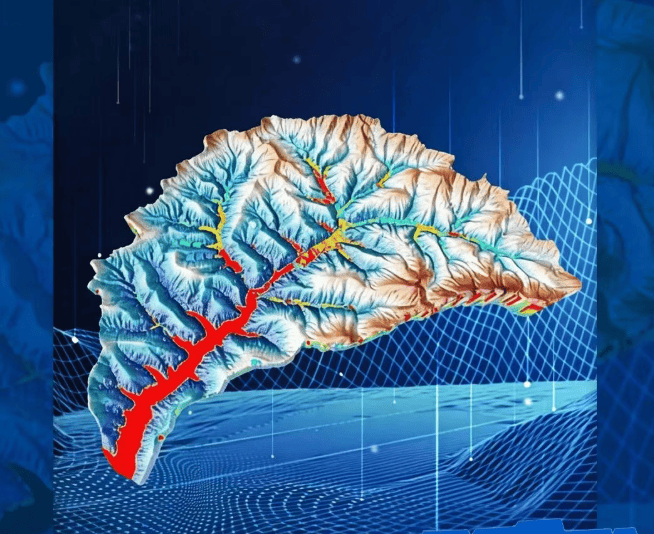
The "Three Calculation" Dilemma of Urban Flood Control
Every flood season, urban waterlogging is a sword hanging over the minds of managers. Where are the water accumulation points? How deep is the water? How long will it take for the water to recede? The answers to these questions directly determine the success or failure of flood control decisions.
However, traditional flood prediction models have long faced three major bottlenecks:
"Inaccurate calculation"—large prediction errors in the location and depth of water accumulation in complex terrain, making decision-making bases unreliable;
"Incomplete calculation"—processes such as surface runoff, pipe network drainage, river flood discharge, and urban waterlogging are fragmented, failing to form a complete picture;
"Slow calculation"—high-resolution simulations often take tens of hours, and by the time results are available, the flood has already receded.
Developing an independently controllable high-performance flood prediction model is urgent.
Three Core Breakthroughs of the GAST Model
After more than a decade of research, the Water Simulation and Disaster Management Research Team at Xi'an University of Technology has successfully developed the Graphics Accelerated Surface Water and its Associated Transport Process Model (GAST model), which has fully independent intellectual property rights. On June 4, 2026, the model was officially unveiled at the National Flood Risk Map Results Seminar, building a "technological barrier" for flood control in over a hundred cities across the country.
High-Precision Robust Algorithm, Error Controlled Within 15%
The GAST model has achieved substantial breakthroughs at the algorithmic level. Compared with measured data, the simulation error of its hydrodynamic elements is controlled within 15%—meaning the prediction accuracy of key parameters such as water accumulation location, depth, and flow velocity has reached a level suitable for engineering application, providing reliable data support for flood control decisions.
Full-Element and Full-Process Coupling, One Model Covers All Scenarios
The biggest drawback of traditional models is their "fragmented approach"—surface water is treated separately from pipe networks, and rivers are treated separately. The GAST model breaks this barrier, achieving full-chain coverage from "rainfall from the sky—surface runoff—pipe network drainage—river flood discharge—urban waterlogging." One model connects all scenarios, making the "cause and effect" of urban flooding clear at a glance.
GPU Acceleration + AI Empowerment, Computation Time Compressed from Hours to Minutes
This is the most impressive breakthrough of the GAST model. In the Qinhan New City of Xi'an-Xianyang New Area, Shaanxi Province, the model covers an area of 302 square kilometers with over 3.68 million computational units—and completing a flood prediction takes only 30 seconds. Computation time has been reduced from tens of hours with traditional models to minutes or even seconds, turning the ideal of "knowing the flood before the rain arrives" into reality.
China's Fully Independent Intellectual Property Rights, Completely Free from Foreign Dependence
The core value of the GAST model lies not only in its technical indicators but also in its independent controllability. The model adheres to independent innovation in core technologies and has been selected for the Ministry of Water Resources' Digital Twin Platform Professional Model Library. This means that China's urban flood prediction field has completely shed its dependence on foreign software and now possesses its own "flood control brain."
From "bottleneck" to "confidence," the unveiling of the GAST model marks a new stage of independent innovation in China's urban water disaster simulation and prevention.
From Over a Hundred Cities to China's National Water Network
The GAST model currently supports flood control projects in over a hundred cities across China, and its application scenarios are rapidly expanding:
Urban Flood Control Emergency Command: Minute-level predictions allow decision-makers to accurately predict water accumulation points and depths before heavy rainfall arrives, enabling proactive deployment of drainage resources and transforming "passive response" into "active defense."
Digital Twin Water Conservancy System: The GAST model has been selected for the Ministry of Water Resources' Digital Twin Platform Professional Model Library and is deeply integrating into the national water network construction. In urban digital twin systems, it will serve as the "computational engine" simulating the entire process of "rainfall-runoff-waterlogging-recession."
Sponge City Construction Evaluation: The model can quantitatively assess the effectiveness of different sponge city facilities in reducing urban waterlogging, providing scientific basis for sponge city planning.
Looking toward the "15th Five-Year Plan," the GAST model, as a more precise and efficient "Chinese chip," will safeguard the tranquility of rivers and the safety of the people.