
Shield tunneling machines bore through rivers and seas, with disc cutters on the cutterhead acting like "teeth" to continuously cut through rock and soil, wearing out rapidly and requiring frequent replacement. For a long time, replacing a single disc cutter required three workers to enter the pressurized chamber for over four hours, facing multiple life-threatening risks such as soil collapse, water and sand ingress, and decompression sickness. Now, this situation has been completely rewritten—on June 25, China's first heavy-duty intelligent shield cutter-change robot was officially deployed on the "Xiamen-Kinmen" shield machine at the Huandao Road Tunnel of the Xiamen-Kinmen Bridge (Xiamen Section). This marks a new era of unmanned cutter change in large-diameter shield tunnel construction in China.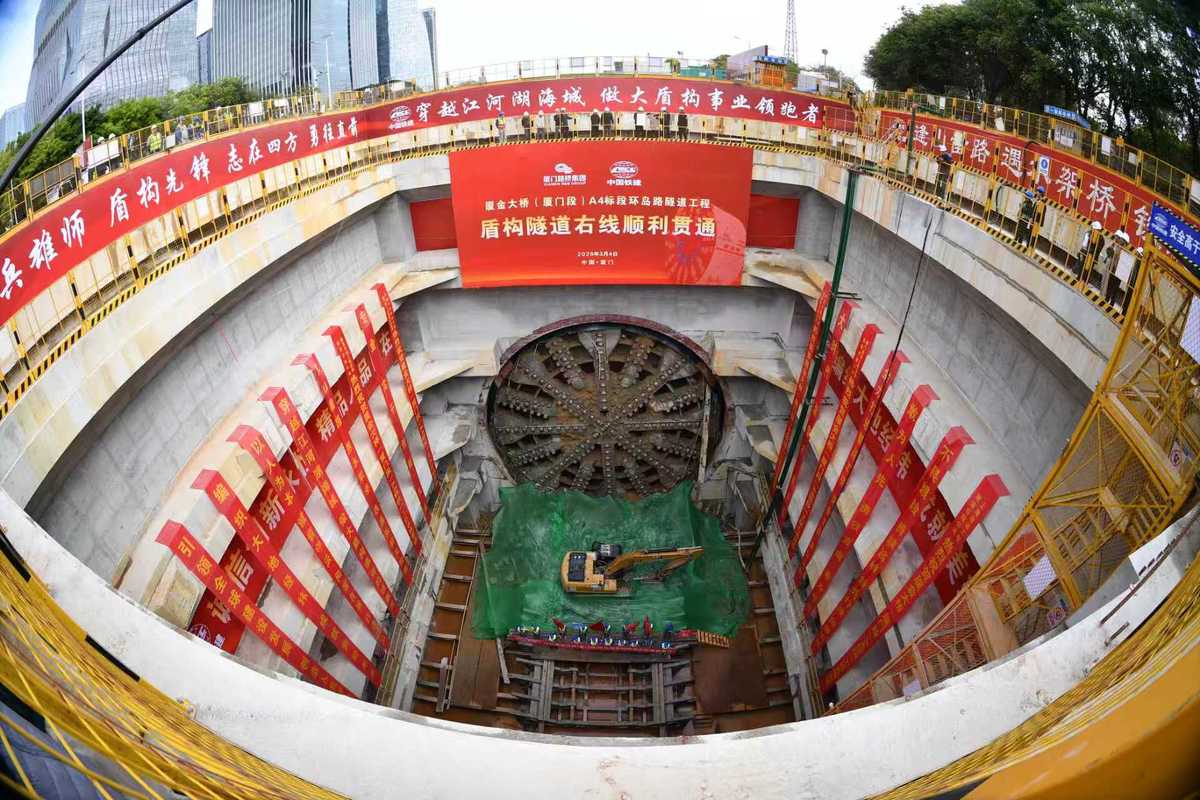
International Challenge of "Difficult and Dangerous Cutter Change"
Shield tunneling machines are major national equipment for crossing rivers and seas. During tunnel excavation, the disc cutters on the cutterhead, akin to "teeth," continuously cut through rock and soil, wearing out quickly and requiring frequent replacement. However, traditional cutter change operations have long faced severe challenges.
Traditional cutter change requires three workers to enter the pressurized chamber for replacement, taking over four hours. The chamber is cramped, dimly lit, hot, humid, and filled with stale air, making movement difficult for workers and exposing them to multiple safety risks, including face instability, harmful gases, and decompression sickness.
The Huandao Road Tunnel of the Xiamen-Kinmen Bridge (Xiamen Section) spans 3,291 meters with an excavation diameter of 16.15 meters, making it the largest-diameter shield tunnel in Fujian Province. The tunnel passes beneath a core bustling area, traverses long sections of upper-soft and lower-hard composite strata, with a minimum overburden depth of only 8.1 meters. Due to the high groundwater level near the coastline, cutter wear rates are accelerated. The internationally recognized industry challenge of "difficult and dangerous cutter change" is further amplified here.
Four Core Technologies Enable the Leap from "Manned" to "Unmanned"
To address these technical pain points, the technical team of China Railway 14th Bureau Group, after dozens of research discussions and multi-level project approvals, developed an intelligent cutter-change robot based on iterative advancements in technologies such as atmospheric cutter change and saturated pressurized cutter change, achieving the fourth-generation upgrade of shield cutter change technology. The equipment underwent iterative development from a principle prototype to an engineering prototype, ultimately achieving engineering application.
Eleven-Degree-of-Freedom Hybrid Robotic Arm Covers 10-18 Meter Shield Cutterheads
The intelligent cutter-change robot features 11 independently controllable movable joints, offering strong obstacle avoidance and fine operation capabilities. With a 500-kilogram load capacity and a flexible telescopic configuration, it can cover the entire cutterhead of ultra-large-diameter shield machines ranging from 10 to 18 meters, easily gripping heavy disc cutters and completing replacements with precision.
3D Infrared Machine Vision Positioning with Accuracy Within 1 Millimeter
Under complex conditions such as dim lighting and high humidity in the chamber, the robot uses 3D infrared machine vision positioning technology, equipping itself with a high-precision "stereoscopic eye." It can quickly scan and identify the precise position and wear status of each cutter, with positioning accuracy controlled within 1 millimeter.
Digital Twin Intelligent Management Automatically Plans Optimal Cutter Change Path
Based on cutter positioning data, the onboard digital twin intelligent management system receives real-time information and automatically plans the optimal cutter change sequence and robotic arm movement path. The entire cutter change process achieves fully automated intelligent decision-making and execution.
100% Domestic Hardware and Software with Complete Independent Intellectual Property Rights
The robot's entire hardware and software are 100% domestically produced, with complete independent intellectual property rights. To date, it has applied for 38 invention patents, 5 utility model patents, and registered 7 software copyrights.
Cutter Change Efficiency Improved by Over 50%, Completely Eliminating Manual Safety Risks
The deployment of the intelligent cutter-change robot brings revolutionary breakthroughs in two dimensions:
Efficiency Revolution: The time to replace a single disc cutter is reduced from over four hours to 25-40 minutes, with overall operational efficiency improved by over 50%.
Safety Revolution: The entire process requires no personnel to enter the shield pressure chamber, fundamentally eliminating the safety risks of manual pressurized cutter change and comprehensively enhancing the intrinsic safety level of tunnel construction.
Qian Qihu, an academician of the Chinese Academy of Engineering, stated that the development of the intelligent cutter-change robot has achieved results in safety, efficiency, and cost, exploring a new path for the autonomous, unmanned, and intelligent development of China's transportation engineering equipment, and laying a foundation for industrial application. Xiao Mingqing, an academician of the Chinese Academy of Engineering, noted that China Railway Construction Corporation spent six years developing the intelligent cutter-change robot technology, and its successful deployment marks a leap from "manned operations" to "unmanned operations" in shield cutter change.
From Xiamen-Kinmen Bridge to National Cross-Sea Ultra-Large-Diameter Shield Projects
Currently, the intelligent shield cutter-change robot has completed on-machine debugging on the 16-meter-class "Xiamen-Kinmen" shield machine, with all operational parameters passing acceptance. On June 27, the "Xiamen-Kinmen" shield machine began excavation of the left tunnel line, with the intelligent cutter-change robot simultaneously put into practical operation.
Zheng Lianxiao, section manager of the Xiamen-Kinmen Bridge (Xiamen Section) project of Xiamen Road and Bridge Engineering Company, stated that the application of the intelligent cutter-change robot provides solid support for safe and efficient tunnel excavation. The project team will fully support the engineering application of the new technology, jointly creating a replicable and scalable intelligent cutter-change solution to serve as a demonstration for national cross-sea and ultra-large-diameter shield projects.
The application prospects of this technological breakthrough are broad:
Cross-Sea Channel Construction: Widely applicable to ultra-large-diameter shield construction in various ongoing cross-sea channel projects across China;
Urban Deep Tunnels: Providing safe and efficient cutter change support for shield construction under complex strata in urban core areas;
Intelligent Equipment Industrialization: Offering core equipment support for the full-chain intelligent upgrade of shield construction, accelerating China's transportation engineering equipment toward autonomy, unmanned operation, and intelligence.
From "manned" to "unmanned," from "4 hours" to "25 minutes," from "manual pressurized" to "fully unmanned"—this robot "doctor," equipped with an eleven-degree-of-freedom robotic arm, 3D infrared vision, and a digital twin brain, is redefining the safety and efficiency standards of China's tunnel engineering.