
According to Dalian University of Technology, the "Dalian No.1" low-altitude sea-crossing long-endurance composite-wing UAV, independently developed by the university, has successfully completed its maiden flight test over the sea. The core indicators of the aircraft, including payload capacity, range and endurance, and wind resistance, have all met expectations, providing a high-performance practical platform for China to build an integrated "sea-land-air" low-altitude economy ecosystem and strongly boosting the innovative development of the low-altitude economy industry in Liaoning Province.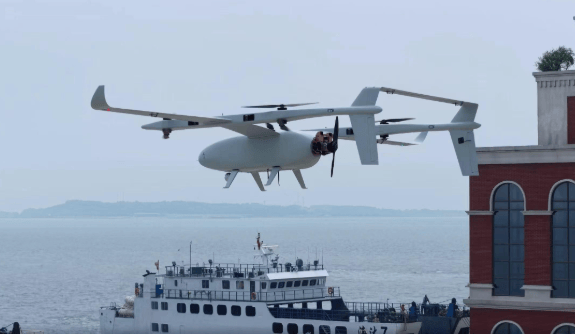
Sea-crossing and maritime operations impose stringent requirements on aircraft, including strong wind resistance, corrosion-resistant structures, long-endurance power, and high anti-interference communication capabilities. Existing mainstream UAVs struggle to fully adapt to complex sea conditions. To address this, the "Dalian No.1" precisely targets the shortcomings of general marine environment equipment, conducting targeted research and development for all essential scenarios related to maritime operations, including nearshore, sea-crossing, and open-sea missions.
The "Dalian No.1" combines the vertical takeoff and landing (VTOL) capability of a helicopter with the high-speed cruise capability of a fixed-wing aircraft. The entire aircraft has a maximum takeoff weight of over 150 kg, a mission payload of 45 kg, a wingspan of 6.5 meters, and a cruise speed of 110 km/h. In terms of technological innovation, the aircraft adopts a bionic seagull wing layout and streamlined surface design, offering outstanding marine technology recognition. Through optimized wing dihedral and spanwise load distribution, it significantly enhances wind resistance and lateral stability. By integrating material and structural design methods, it achieves a structural weight reduction of over 15%. Equipped with an intelligent flight control system based on domestically developed computers and robust wind-resistant control technology, combined with heterogeneous multi-link aggregation and multi-source fusion navigation, it significantly improves communication continuity for beyond-visual-range flights in complex sea conditions. The hybrid oil-electric power system ensures a sea-crossing long endurance of over 1,300 km. The aircraft can perform vertical takeoff and landing in winds of up to Force 6 and maintain stable cruise in winds of up to Force 7, making it highly suitable for diverse full-sea-area operational scenarios such as maritime patrol, material transportation, and emergency rescue.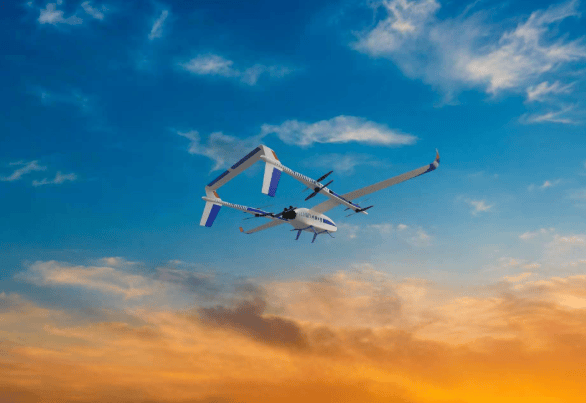
The "Dalian No.1" project integrates multiple cutting-edge technologies. Led by Academician Xiang Changle of the Chinese Academy of Engineering and Professor Wang Bo of Dalian University of Technology, the project brings together research teams from various schools, including Mechanics and Aerospace, Information and Communication Engineering, Control Science and Engineering, Energy and Power Engineering, Architecture and Art, Mechanical Engineering, and Electrical Engineering. Leveraging interdisciplinary advantages, they deeply integrate and collaboratively overcome key technical challenges.
Currently, the research and development team has reached cooperation intentions with multiple functional units. Subsequent plans include conducting routine sea-crossing route test flights, full-dimensional verification of adaptability to extreme marine environments, and simultaneously implementing various application scenarios such as sea-crossing material transportation, island emergency support, marine ecological patrol, and comprehensive maritime supervision, promoting the large-scale implementation of the low-altitude industry. In the future, leveraging the advantages of the Bohai Rim low-altitude industry layout, it will help Liaoning build an innovative pilot demonstration zone for the low-altitude economy in Northeast China, injecting strong scientific and technological momentum into the expansion of China's low-altitude economy across the entire marine domain.