
On July 14, 2026, at a depth of 96 meters below sea level in China's Jiaozhou Bay, the "Deep Blue," a super-large-diameter slurry balance tunnel boring machine (TBM) with an excavation diameter of 15.63 meters, completed its final centimeter of excavation, advancing a total of 3,258 meters. This marks the full completion of the main line TBM excavation for the Qingdao Jiaozhou Bay Second Undersea Tunnel, the world's longest and largest-scale undersea road tunnel. This "undersea dragon," stretching 17.48 kilometers in total length with a 9.95-kilometer sea section, showcases China's top-tier capabilities in super-large-diameter undersea TBM technology through three core breakthroughs: hardcore equipment innovation, intelligent control upgrades, and green, low-carbon construction.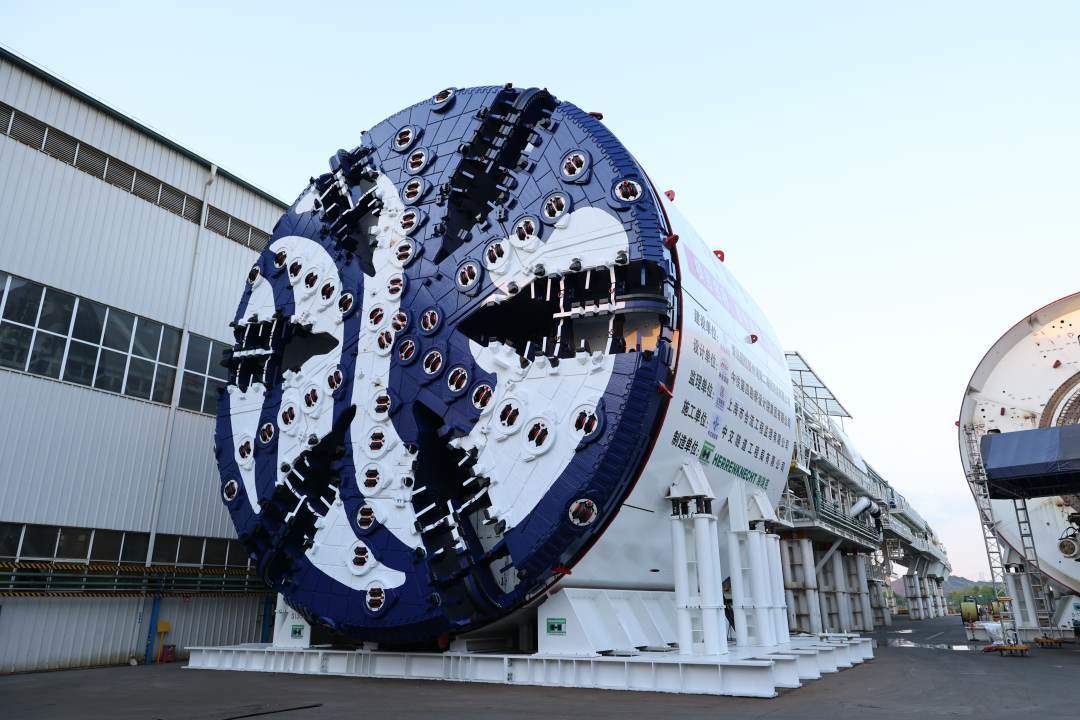
Megaproject: The "Ultimate Challenge" Behind a World Record
The Qingdao Jiaozhou Bay Second Undersea Tunnel connects Qingdao's main urban area with the West Coast New District. With a total length of 17.48 kilometers and a design speed of 80 km/h, it is currently the world's largest and longest undersea road tunnel. The tunnel employs a combined "drill-and-blast + TBM" construction method. The TBM section of the north main line tunnel, undertaken by CCCC Tunnel Engineering Company, is 3,258 meters long.
However, the construction of this "megaproject" was fraught with challenges:
Ultra-High Water Pressure: The lowest point of the TBM section lies 96 meters below sea level, enduring an ultra-high water pressure of 0.96 MPa, equivalent to 35 cars pressing down on every square meter.
Dense Fault Zones: The route crosses 22 undersea fault zones.
Complex Strata: The TBM advanced for long distances alongside undersea fault zones, requiring it to traverse full-face hard rock and fractured zones. The rock strength in the area is uneven, surrounding rock stability is poor, and soil permeability is extremely high.
Launching Risks: The launching area consisted of backfill soil, which is soft, with limited space for TBM disassembly and significant risks associated with undersea cross-passage excavation.
"With the vast ocean overhead and complex hydrogeological conditions, the high water pressure and strong corrosiveness of seawater impose extremely high demands on the durability of the tunnel structure and construction safety," said Gan Congyu, Project Manager of CCCC Tunnel Engineering Company, describing the construction difficulty.
Hardcore Equipment Innovation: Three "Unique Skills" Conquer Undersea Tunneling Challenges
Facing multiple world-class challenges, the project team tailored three core technological breakthroughs for the "Deep Blue":
"Short Screw Conveyor + Crusher + Crushing Box": A Domestic First, Eliminating Slag Blockage
When super-large-diameter TBMs tunnel undersea, mud and large rock fragments easily clog the output system—a persistent industry problem. The "Deep Blue" employs a "short screw conveyor + crusher + crushing box" combination structure, applied for the first time in China. By installing a crusher inside a crushing box in the slurry discharge pipeline, this solution crushes large rocks before discharge, effectively solving the industry-wide issue of slag retention undersea.
Multi-Information Fusion Cutter Wear Assessment: From "Passive Tool Change" to "Proactive Warning"
For long-distance hard rock tunneling undersea, cutter wear is a critical factor determining project success. The "Deep Blue" established a multi-information fusion cutter wear assessment system. By monitoring cutter operational status data in real time, combined with geological conditions and tunneling parameters, this system upgrades traditional "passive tool changes" to "proactive warnings," ensuring safety and efficiency during long-distance excavation.
Retractable Main Drive + Excavation Chamber Visual Monitoring: Giving the TBM "All-Seeing Eyes"
The "Deep Blue" is also equipped with a retractable main drive and an excavation chamber visual monitoring system, allowing operators to observe muck conditions and cutter status in real time. The entire TBM has an excavation diameter of 15.63 meters, a total length of 160 meters, and a weight of 4,600 tons, capable of withstanding ultra-high water pressure of 0.96 MPa, making it a true "behemoth" of undersea TBM technology.
Intelligent Control System: 5G + BeiDou + Digital Twin, Site-Wide "One-Map" Dispatch
The "Deep Blue" is not only a culmination of hardcore equipment but also a deep practice of "Intelligent Manufacturing in China":
A digital twin smart platform enables fine-grained control over the entire process, leveraging 5G, BeiDou positioning, and BIM digital construction systems to build an integrated control network covering personnel, equipment, and tunnel structure. On-site inspections, quality checks, and measurement and payment are all closed-loop online, with native electronic archives replacing traditional paper documents, achieving intelligent "one-map" site dispatch. Additionally, an automated monitoring system for muck and slurry, along with a dynamic tunneling analysis system, was innovatively developed to enable real-time optimization of tunneling parameters, ensuring smooth and efficient construction.
Green Construction Practices: Nearly One Million Cubic Meters of Water Saved, Energy Consumption Reduced by 75%
Green construction was integrated throughout the project's lifecycle:
The project recycled reclaimed water from a sewage treatment plant to replace freshwater for construction, saving nearly 1 million cubic meters of freshwater resources. A wastewater treatment system enabled the recycling of construction water. An integrated "production-transport-injection" synchronous grouting system reduced thousands of underground transport trips. An air-source heat pump water heating system cut energy consumption by 75%. These seemingly minor green practices allowed this megaproject to break away from the traditional path of "large-scale construction, large-scale consumption."