
On August 26, the Heihe–Daqing natural gas pipeline project, part of the national oil and gas development "15th Five-Year Plan," officially broke ground in Sunwu County, Heilongjiang Province. Once completed, the pipeline will further consolidate the national strategic oil and gas corridor, injecting strong momentum into safeguarding national energy security and promoting the comprehensive revitalization of Northeast China in the new era.
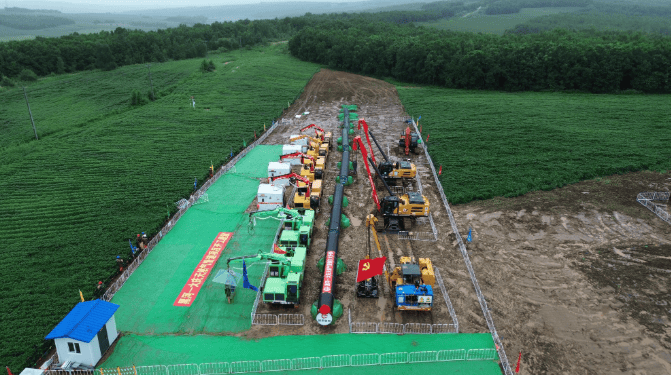
The Heihe–Daqing natural gas pipeline project officially commences.
The Heihe–Daqing natural gas pipeline spans 578.3 kilometers, passing through 10 counties (districts) across four cities in Heilongjiang Province: Heihe, Qiqihar, Suihua, and Daqing, with a design pressure of 12 megapascals. The project will be connected to the planned Daqing–Changling natural gas pipeline, and upon operation, it will operate jointly with the "Northern Gas Southbound" energy corridor, forming a dual-channel pattern for southbound gas transmission.
"Once the pipeline is operational, it will boost the annual gas transmission capacity of the 'Northern Gas Southbound' system from 38 billion cubic meters to 48 billion cubic meters, effectively enhancing the resource allocation and transmission capabilities of the Northeast energy corridor, improving the layout of the natural gas pipeline network in Northeast China, and driving clean energy utilization and industrial upgrading along the route," said Liu Shang, manager of the Harbin Project Division of PipeChina Project Management Company.
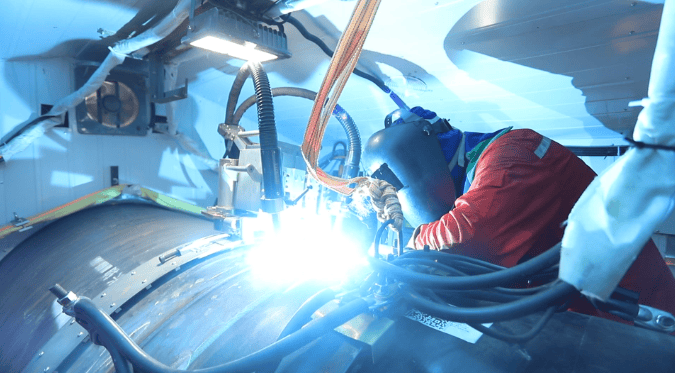
The automatic welding ratio for large-diameter pipelines across the entire line exceeds 96%.
The project adopts intelligent and standardized construction practices, promoting the use of 18-meter extended pipes to reduce the number of girth welds by approximately 30%. The automatic welding ratio for large-diameter pipelines across the entire line exceeds 96%, and girth welds are inspected using a combined standard of fully automatic ultrasonic testing and digital radiography, enhancing the intrinsic safety level of the pipeline.
According to reports, PipeChina has integrated ecological and environmental protection throughout the entire pipeline design and construction process, with all major and medium river crossings utilizing trenchless methods such as directional drilling. The pipeline construction employs targeted measures such as reducing the width of the right-of-way to traverse black soil areas, and implements systematic protection measures including topsoil stripping, covering, plowing, and fertilization, achieving coordinated development between project construction and ecological environmental protection.
The "15th Five-Year Plan for Oil and Gas Development," recently issued by the National Development and Reform Commission and the National Energy Administration, specifies that during the "15th Five-Year Plan" period, China will complete the Heihe–Daqing–Changling, Hulin–Changchun–Shijiazhuang, and the second line of the Sichuan-to-East Gas Transmission pipelines, establishing a central "cross-shaped" backbone corridor; initiate construction of the fourth line of the West-to-East Gas Transmission (Wuqia–Turpan section) and the fifth line of the West-to-East Gas Transmission when appropriate; and plan the launch of a new southbound gas transmission corridor from Sichuan. By 2030, China will add 20,000 kilometers of new long-distance oil and gas pipelines, bringing the total length of the national long-distance oil and gas pipeline network to 220,000 kilometers.