
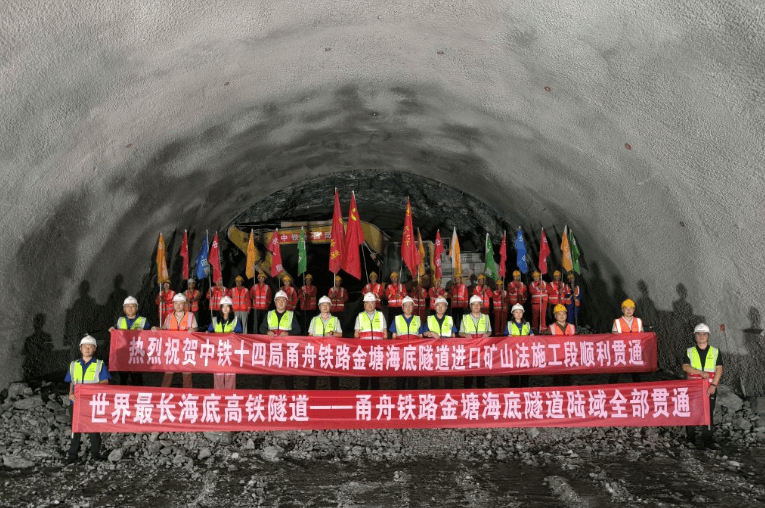
On September 4, with the final rock wall at the entrance of the Jintang Undersea Tunnel on the Yongzhou Railway being breached, the land section of the world's longest undersea high-speed railway tunnel has been fully completed.
The Jintang Undersea Tunnel is a key control project of the entire Yongzhou Railway, stretching from Beilun in Ningbo in the west to Jintang in Zhoushan in the east. With a total length of 16.18 kilometers, it is a single-tube double-track tunnel designed for a speed of 250 kilometers per hour, setting a new world record for the longest undersea high-speed railway tunnel. The tunnel is divided into two major sections: the land section and the sea section, with the land section spanning a total of 7.83 kilometers.
The entrance section completed this time is located on the Beilun side of Ningbo and was constructed by China Railway 14th Bureau Group. The main tunnel is 3,617 meters long, traversing multiple fault zones and densely jointed areas. Qiu Lixu, the on-site manager of the Second Sub-division of the Second Work Zone of the Yongzhou Railway Project under China Railway 14th Bureau Group, stated that in response to the complex geological conditions, the construction team adopted a combination of smooth blasting and millisecond delay blasting techniques, strictly controlling the impact of blasting vibrations. Relying on a dual early warning system of advanced geological forecasting and surrounding rock monitoring and measurement, the team ensured the safe completion of the tunnel.
The main line of the Yongzhou Railway spans 76.4 kilometers in total, with the overall construction progress currently reaching 77%. With the full completion of the land section of the Jintang Undersea Tunnel, the project's focus has fully shifted to the shield tunneling construction of the sea section of the Jintang Undersea Tunnel. Next, key works such as completing the undersea shield tunneling section and laying ballastless track will be advanced, laying a solid foundation for the early opening of the Yongzhou Railway. Once the Yongzhou Railway is operational, the high-speed rail journey from Ningbo to Zhoushan will take as little as 26 minutes, and the trip from Hangzhou to Zhoushan will be shortened to about one and a half hours, which is of great significance for effectively promoting the integrated development of Ningbo and Zhoushan.