
A team led by Academician Zheng Nanfeng and Professor Wu Binghui of Xiamen University has made important progress in perovskite solar cell research. They proposed using Prussian blue frameworks to synergistically regulate perovskite material formation, defect evolution, and ion migration and distribution during device operation, offering a new solution for improving the stability of perovskite photovoltaics. On September 25, the related research results, jointly completed by the team with collaborating institutions including Jinan University and Tsinghua University, were published in the international academic journal Science.
Prussian blue is regarded as the first modern synthetic pigment in human history and is widely used in painting, printing, and cyanotype imaging. At the same time, its special structural and chemical characteristics, such as its open framework structure and mixed-valence centers, demonstrate application potential in the study of ion storage, ion transport, and redox processes.
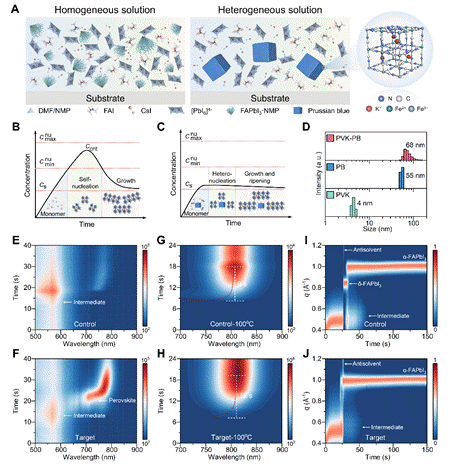
Prussian blue guides the perovskite crystallization process. Xiamen University official website
In this study, the researchers introduced Prussian blue nanoparticles into the perovskite light-absorbing layer. By leveraging their lattice characteristics similar to those of perovskite, reversible redox activity, and open framework structure, the nanoparticles were made to participate simultaneously in the regulation of two stages: material formation and device operation. The study found that after the introduction of Prussian blue, the nucleation, intermediate phase transformation, and crystal growth processes of perovskite were effectively regulated, ultimately forming films with more pronounced preferred orientation and lower local strain; under an applied electric field, long-range ion migration and redistribution were suppressed, and electric-field-induced local potential changes were also significantly reduced.
To test the applicability of this material strategy under different device structures and area scale-up conditions, the research team conducted verification in both regular and inverted perovskite solar cells. After the introduction of Prussian blue, the photoelectric conversion efficiencies of both types of small-area devices exceeded 26%; during area scale-up, a 6 cm × 6 cm regular-structure module achieved an efficiency of 23.4%; a 30 cm × 30 cm inverted-structure module achieved an efficiency of 22.9%.
This study treats the formation of the perovskite thin film and device operation as an interrelated continuous process, and uses the chemical properties of Prussian blue to synergistically regulate crystal growth, defect transformation, and ion migration, providing a new approach for designing open framework materials that combine structural guidance, redox buffering, and ion regulation functions.