
Recently, the global field of quantum precision measurement has seen a succession of landmark advances. A team from Tsinghua University in China and a joint research team from several European countries published research results on nuclear optical clocks in Nature almost simultaneously, achieving stable closed-loop operation of thorium-229 nuclear optical clocks through different technical approaches—marking the first time humanity has extended a functioning timekeeping reference from the atomic outer-electron energy levels deep into the atomic nucleus.
Thorsten Schumm, an atomic physicist at TU Wien in Austria and a key member of the European team, acknowledged that building a nuclear optical clock is "a dream come true." Not long ago, the field was "a quiet niche," he said. "Now we have fierce but friendly global competition."
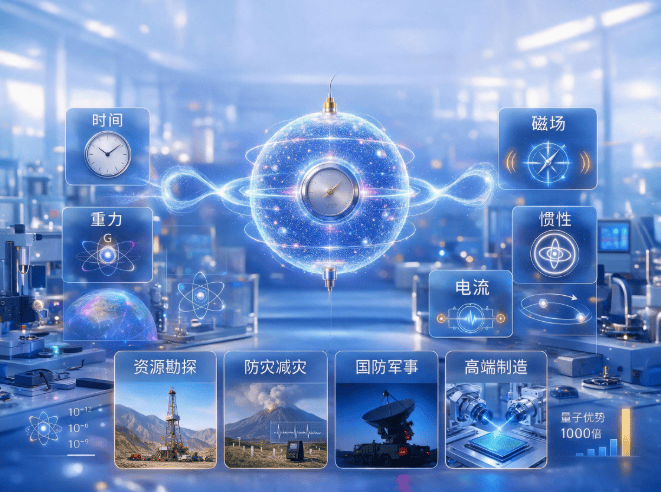
Image generated by AI
Nuclear optical clocks expected to surpass atomic clocks in precision
For a long time, the time reference of the modern technological system has been provided by atomic clocks, which rely on energy-level transitions of atomic outer electrons for timekeeping and underpin the precise operation of satellite navigation, power and communications, deep-space exploration, and other fields. However, electron energy levels are susceptible to interference from temperature, magnetic fields, electromagnetic pulses, and other external environmental factors, and their precision has gradually approached the theoretical ceiling. Nuclear optical clocks use energy-level transitions of the atomic nucleus as a "metronome," which in principle is less susceptible to external interference and is expected to achieve higher precision and stability than existing top atomic clocks. As a result, they have become a frontier direction pursued jointly by the global metrology and physics communities.
In 2024, three research teams, including the U.S. National Institute of Standards and Technology (NIST), reported that they had used lasers to trigger the clock transition within the thorium nucleus. Previously, the energy of these jumps had only been measured indirectly. Physicists directly observed the nuclear transition signal for the first time, completing the leap from theoretical prediction to experimental verification, but continuous timekeeping with closed-loop locking had not yet been achieved at that time.
In 2026, technical breakthroughs entered a concentrated harvest period. In June, a European team comprising institutions such as TU Wien and the German Federal Physical-Technical Institute released a preprint describing a thorium-229 optical nuclear clock with a feedback loop; in October, the Tsinghua University team and the European team published formal results in Nature almost simultaneously, each achieving stable closed-loop operation of a nuclear optical clock through different technical routes: the European team adopted a high-concentration thorium crystal light-tube absorption readout scheme, while the Chinese team adopted a self-developed 148 nm vacuum ultraviolet laser and a low-concentration thorium-doped calcium fluoride crystal scheme, with each achieving breakthroughs in second-level stability metrics.
Gilad Perez, a theoretical physicist at the Weizmann Institute of Science in Israel, commented on the two works at the same time, stating that the nuclear optical clock has evolved from "a promising system" into "a usable precision instrument" capable of exploring new physics. In his view, this is only the starting point for accelerated development in the field.
In an official technical assessment released in August, NIST noted that the nuclear optical clock prototypes of both teams currently operate reliably, with a single-day frequency drift corresponding to an error of about 1 second in 3 million years, but they have not yet surpassed the long-term precision of the current top traditional atomic clocks, which do not exceed 1 second of error in 40 billion years. Improving vacuum ultraviolet laser efficiency, optimizing crystal materials, miniaturizing systems, and enhancing environmental adaptability are all core directions for the next round of joint efforts by teams across countries.
Focus of competition shifts to "whether it can be used"
The dense breakthroughs in nuclear optical clocks are just a microcosm of global competition in quantum precision measurement. As one of the three core directions of quantum technology, quantum precision measurement uses the properties of quantum states to achieve ultra-high-precision measurement of physical quantities, covering multiple dimensions such as time, gravity, magnetic fields, electric current, and inertia. Known as the "quantum-level ruler," it is gradually moving from basic research toward practical application scenarios such as resource exploration, disaster prevention and mitigation, national defense and military industry, and high-end manufacturing.
Major science and technology countries around the world have elevated quantum precision measurement to a strategic competitive domain. For example, quantum gravimeters can be used in underground resource exploration and geological monitoring scenarios. Among the high-precision quantum gravity devices developed by the U.S. company AOSense, some products have entered the engineering stage, with NASA and energy companies as important users. Through its "Quantum Flagship" program, the European Union plans to invest 1 billion euros before 2030 to integrate multinational research efforts and promote the commercialization of quantum sensing technology, forming strong industrial conversion capabilities in the fields of quantum magnetometers and atomic interferometers. Japan and South Korea have also successively issued special strategies to strengthen R&D and export controls in quantum precision measurement technology.
The focus of competition is gradually shifting from "whether it can be measured" to "whether it can be used." In the field of time and frequency, in addition to frontier exploration of nuclear optical clocks, mature technical routes such as optical lattice clocks are also undergoing continuous iteration. The strontium atomic optical lattice clock developed by a team at the University of Science and Technology of China has achieved stability and uncertainty both broken through the 10-19 level, placing it among the international advanced tier and providing Chinese data for the redefinition of the SI "second."
Michael Biercuk, CEO of the quantum control company Q-CTRL, stated that quantum sensing is the branch of quantum technology closest to commercialization and "the biggest near-term winner."
A report titled "The Quantum Revolution: A Guide for Allied Policymakers," released by the Hoover Institution at Stanford University in July of this year, shows that among the three major directions of quantum computing, quantum communication, and quantum precision measurement, quantum sensing—the core application form of quantum precision measurement—has the shortest commercialization path.
Application conversion at a critical stage
Overall, global quantum precision measurement remains at a critical stage of transition from basic research to application. Even the fastest-progressing nuclear optical clock is currently only a laboratory prototype device, bulky and demanding in operating conditions. Subsequent engineering efforts in miniaturization, low power consumption, and environmental adaptability, as well as adaptation to spaceborne, vehicle-mounted, and shipborne scenarios, are core challenges facing all countries in the next stage. Moreover, in upstream segments such as high-end quantum sensor chips and core optoelectronic devices, global industrial chains all have shortcomings to varying degrees.
Ding Shiqian, an associate professor at Tsinghua University, stated that this breakthrough opens a possible path toward compact and robust optical clocks in navigation and communication devices. Schumm stated that nuclear optical clocks using crystals are already under commercial development.
"Previously, the transparent crystals needed to host thorium-229 were technically demanding and expensive to produce, which posed a real limitation on any practical application," Harry Morgan, a lecturer in theoretical chemistry at the University of Manchester in the UK, noted in a commentary on nuclear optical clock research. "This new approach is an important advance for the future of nuclear optical clocks. There is no doubt that such devices are feasible and may be closer than anyone expected."
NIST's "NIST on a Chip" program reflects this shift: compressing high-precision measurement capabilities that could previously only be achieved in national metrology laboratories into chip-scale devices and bringing them to real-world scenarios such as factories, hospitals, and the field.
In this global race, China has become an important participant by virtue of its complete industrial system, sustained research investment, and vast application market. In sub-directions such as time and frequency, quantum magnetometers, and quantum current sensing, the results of Chinese research teams are in the international first tier, while engineering conversion and industrial ecosystem construction are also being accelerated. As investment from various countries continues to increase, technological iteration and industrial implementation in the field of quantum precision measurement are expected to further accelerate, bringing new underlying momentum to global scientific and technological development.