
A research team from the Yunnan Observatories of the Chinese Academy of Sciences, in collaboration with domestic and international partners, has confirmed that the asteroid designated 2024 XA1 is the fastest-rotating near-Earth asteroid known to date. The relevant research was published in the international journal The Astronomical Journal.
Near-Earth asteroids are asteroids with a perihelion distance of less than 1.3 astronomical units. Among them, near-Earth asteroids with a diameter greater than 140 meters and a minimum orbital intersection distance with Earth of less than 0.05 astronomical units are defined as potentially hazardous asteroids. According to statistics from the International Astronomical Union, as of October 10 this year, 42,752 near-Earth asteroids had been confirmed, including 2,542 potentially hazardous asteroids.
Asteroid 2024 XA1 entered Earth's atmosphere over eastern Siberia in the early hours of December 4, 2024, Beijing time. Only about 10 hours elapsed from its discovery to its atmospheric entry, making it the 11th successfully predicted near-Earth asteroid impact event by humanity. Led by Zhang Xiliang, a young researcher at the Yunnan Observatories, and Fan Xiangyu, a doctoral student, the team used the Lijiang 2.4-meter telescope to capture observation images during the final one-hour window before the asteroid's fall, in which a bright streak appears.
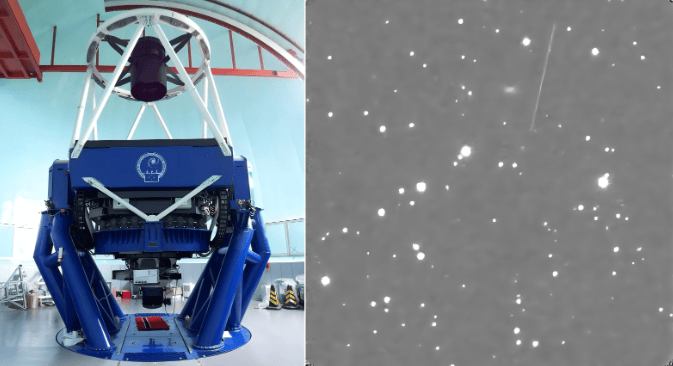
Image of the Lijiang 2.4-meter telescope and near-Earth asteroid 2024 XA1. Source: Yunnan Observatories
To this end, the research team developed a method for reconstructing asteroid light curves adapted to streak images, extracting brightness information along the asteroid's trajectory and comparing model images with the original images to verify the reconstruction performance, ultimately recovering its light curve. The study shows that 2024 XA1 has a rotation period of only 1.63 seconds, breaking the previous record of 2.58 seconds held by another asteroid; its equivalent diameter is about 0.55 meters—very small in size yet astonishingly fast in rotation. Under such extremely rapid rotation, the centrifugal force on the surface of the body far exceeds its own gravity, indicating that it is not a rubble pile but a complete, hard, solid rock that maintains its intact form through the strength of the rock itself. It is speculated that it may be a fragment produced by the collision and breakup of a larger body, or formed by accelerated rotation under solar radiation torque.
Near-Earth asteroid monitoring is crucial to Earth's safety, but meter-scale asteroids are small and fast-moving, making their physical parameters difficult to obtain. This new streak-image analysis method can efficiently resolve the rotation and structural information of fast-moving asteroids, enhancing the ability to obtain physical characteristics of asteroids in impact warning events and providing scientific support for deploying and conducting planetary defense missions.