
On October 29, Wang Bing and Fan Qitang's teams at the Hefei National Research Center for Physical Sciences at the Microscale, University of Science and Technology of China, together with collaborators, completed the experimental preparation and electron transport verification of a new type of metallic carbon nanoribbon. The material consists solely of five-membered and seven-membered rings, with a carbon skeleton width of approximately 0.9 nanometers, and the conductance of a single nanoribbon reaches up to about 0.9 conductance quanta. The related research results were published online on October 28 in the international academic journal Nature, and were announced by USTC on October 29.
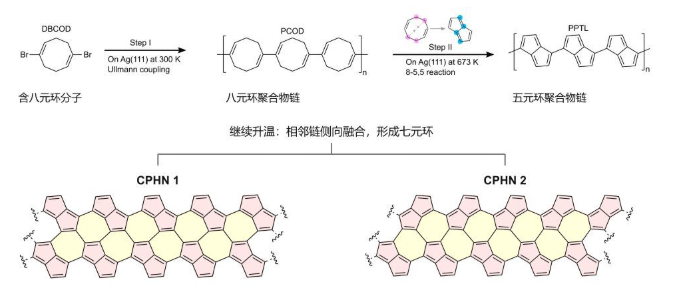
The research team adopted a stepwise on-surface synthesis approach, using stable molecules containing eight-membered carbon rings as starting monomers. First, the molecules were linked into chains on a silver surface, and then through heating, the eight-membered rings rearranged into paired five-membered rings, forming polycyclopentadiene intermediates. Upon further heating, adjacent molecular chains underwent lateral fusion, generating seven-membered rings between the chains, ultimately producing five-seven-ring carbon nanoribbons. High-resolution microscopy imaging confirmed the arrangement of carbon rings within the material.
The experiments yielded two types of nanoribbons with different arrangements, designated CPHN1 and CPHN2. Both consist of five-membered and seven-membered rings, but differ in electronic properties: CPHN1 exhibits metallic behavior, while CPHN2 is a narrow-bandgap semiconductor. Through quasiparticle interference measurements and theoretical calculations, the research team confirmed that the electronic band of CPHN1 crosses the Fermi level, whereas CPHN2 has a bandgap of approximately 0.22 electron volts.
In electron transport tests, the researchers used a scanning tunneling microscope tip to connect to and lift one end of a single nanoribbon, establishing a nanoscale current path between the tip and the silver surface. Under low-temperature conditions and a 10-millivolt bias voltage, the conductance of CPHN1 remained essentially stable as the lifting length increased to approximately 4 nanometers, exhibiting near-ballistic electron transport characteristics. In contrast, the conductance of CPHN2 was approximately two orders of magnitude lower, with current significantly suppressed under low-voltage conditions.
The experiments also combined surface structural characterization, synchrotron radiation photoelectron spectroscopy, and theoretical calculations. The University of Science and Technology of China is the first completing institution and the sole corresponding institution of the paper, with researchers from Nankai University participating in the synthesis of precursor molecules. The research results are currently at the stage of material synthesis and transport performance verification of single nanoribbons, and the paper identifies carbon-based electrodes and atomic-scale interconnects as potential application directions.