
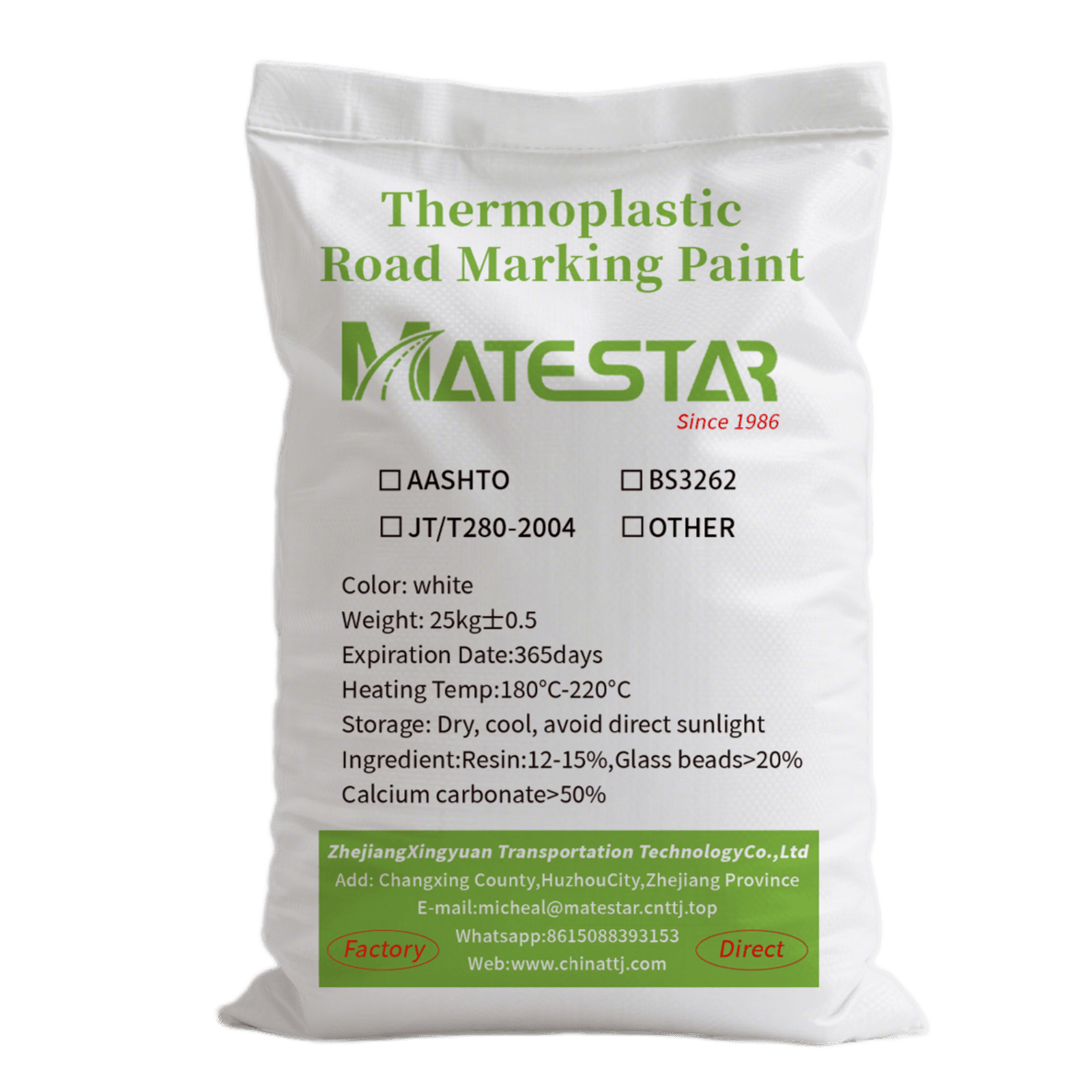

Spray thermoplastic road marking paint for high-speed road line marking, highway edge lines, center lines and maintenance projects. Suitable for spray thermoplastic machines, long-distance road markings and bulk road marking paint supply.
Color customized:White/Yellow/Blue/other color could be customized
MOQ: 1 Ton,Fast Delivery:5-10 Days
Supporting: Free Samples
Related Keywords Used:thermoplastic road marking paint, thermoplastic road marking, thermoplastic paint, road marking paint, road markings, road lines, road line marking, road marking machine, thermoplastic machine, glass beads for road marking, pavement marking, hot applied thermoplastic, spray road marking paint
Spray Thermoplastic Road Marking Paint
Hot-applied spray thermoplastic paint for faster road line marking and maintenance projects.
MATESTAR Spray Thermoplastic Road Marking Paint is a hot-applied thermoplastic material designed for spray application. It is suitable for highway edge lines, center lines, skip lines, long-distance road markings and road maintenance projects where faster application and lower material consumption are required.
Compared with screed thermoplastic road marking paint, spray thermoplastic is applied through a thermoplastic spray road marking machine. The molten material is sprayed onto the pavement under pressure, forming a thinner and more uniform road marking layer.
It is especially suitable for contractors who need efficient road line marking on highways, city roads and large-scale maintenance projects.
Key Advantages
- Fast application for long-distance road lines
- Lower material consumption than thick screed markings
- Smooth and uniform line appearance
- Good adhesion to asphalt pavement
- Suitable for highway edge lines and center lines
- Reflective road markings with glass beads
- Custom formula for hot climate and project requirements
- 25kg bag packing for bulk road marking paint supply
What Is Spray Thermoplastic Road Marking Paint?
Spray thermoplastic road marking paint is a hot applied thermoplastic paint used with a spray thermoplastic road marking machine.
The material is first heated in a thermoplastic preheater until it becomes fully molten. Then it is transferred to the spray marking machine and applied through a nozzle under pressure. After cooling, it forms a durable road marking layer on the pavement.
Spray thermoplastic is different from cold spray road marking paint. Cold spray paint is usually water-based or solvent-based liquid road paint applied at normal temperature. Spray thermoplastic is still a hot melt thermoplastic road marking material and must be heated before application.
This product is mainly used when the project needs faster construction speed, thinner marking thickness and efficient road line marking over long distances.
Why Choose Spray Thermoplastic Road Marking Paint?
Faster Road Line Marking Speed
The biggest advantage of spray thermoplastic road marking paint is application efficiency.
For long-distance road lines, using screed thermoplastic can be slower because the material is applied through a shoe or screed box. Spray thermoplastic is applied through a spray nozzle, which allows the road marking machine to work at a higher speed.
This makes it suitable for:
- Highway edge lines
- Center lines
- Skip lines
- City road lane markings
- Long-distance pavement marking
- Road maintenance and re-marking projects
For contractors, faster application means shorter road closure time, lower labor cost and better project efficiency.
Lower Material Consumption
Spray thermoplastic road marking paint usually forms a thinner marking layer than screed thermoplastic. In many projects, spray-applied thermoplastic markings are used at around 0.8–1.2mm, depending on local specification, road condition and machine setting.
Because the coating is thinner, material consumption is lower. This makes spray thermoplastic a practical choice for long road lines where the marking does not need to be as thick as zebra crossings, stop lines or heavy-wear intersection markings.
However, thinner does not mean lower quality. The formula must still provide proper adhesion, wear resistance and retroreflectivity.
Smooth and Uniform Line Appearance
Spray thermoplastic can create a smooth and even road marking surface when the material viscosity, spray pressure, nozzle condition and machine speed are properly controlled.
This is important for road lines that require neat visual appearance, such as:
- Highway lane lines
- Edge lines
- Center lines
- Urban road markings
- Maintenance lines over old markings
A stable spray formula helps reduce rough edges, uneven thickness and material blockage during construction.
Good Adhesion to Pavement
Spray thermoplastic road marking paint can bond well with asphalt pavement when the road surface is clean and dry. For concrete roads, old road surfaces or weak pavement conditions, primer is recommended to improve adhesion.
Good adhesion depends on several factors:
- Road surface cleaning
- Proper primer application
- Stable heating temperature
- Correct spray pressure
- Suitable material viscosity
- Proper glass bead application
If the road surface is wet, dusty or contaminated with oil, the marking may peel off even if the thermoplastic paint itself is good.
Spray Thermoplastic vs Screed Thermoplastic
| Item | Spray Thermoplastic Road Marking Paint | Screed Thermoplastic Road Marking Paint |
|---|---|---|
| Application Method | Sprayed through nozzle under pressure | Applied by screed box or shoe |
| Material State | Hot molten thermoplastic | Hot molten thermoplastic |
| Typical Thickness | Thinner, often around 0.8–1.2mm depending on project | Usually thicker, often 1.5–3.0mm depending on project |
| Application Speed | Faster | Slower |
| Material Consumption | Lower | Higher |
| Line Appearance | Smooth and uniform | Thick and solid |
| Best Use | Edge lines, center lines, skip lines, maintenance lines | Zebra crossings, stop lines, arrows, high-wear areas |
| Equipment | Spray thermoplastic road marking machine | Screed thermoplastic road marking machine |
| Cost Efficiency | Better for long-distance road lines | Better for durable thick markings |
Application Method
Spray thermoplastic road marking paint is applied by a dedicated thermoplastic spray road marking machine.
Typical construction process:
- Clean the road surface
- Mark the line layout
- Apply primer if needed
- Heat thermoplastic paint in preheater
- Keep the material fully melted and stirred
- Transfer molten material to spray road marking machine
- Spray the line through nozzle under pressure
- Apply drop-on glass beads immediately
- Allow the marking to cool before opening traffic
Recommended application temperature:
Usually around 190–220°C, depending on formula, machine condition and local climate.
