en.Wedoany.com Reported - Zhang Xianghong, a member of the National Data Expert Advisory Committee and a professor at Beijing Jiaotong University, recently provided an in-depth interpretation of a series of recently released policies, focusing on hot topics such as the construction of high-quality industrial datasets and the implementation of the "Model-Data Resonance" initiative. Zhang pointed out that artificial intelligence has entered the stage of large-scale application, but the industrial sector still faces core bottlenecks such as insufficient supply of high-quality data and a disconnect between data, models, and scenarios.
Zhang stated that AI is currently at a development singularity, having moved past the learning phase into large-scale application. In 2025, China's domestic AI inference data volume reached 101.34 EB, surpassing the training data volume of 98.14 EB for the first time, and the proportion of network intelligent agent traffic also far exceeded that of humans. However, there remains a shortage of high-quality datasets for both general industry knowledge and specialized industry knowledge. The widespread application of large model technology in real-world settings like industrial manufacturing still lacks practical feedback and validation.

A series of recent documents have provided top-level design and implementation pathways for the digital and intelligent transformation of the manufacturing industry. The "Implementation Plan for Promoting the Construction of High-Quality Industry Datasets" proposes to build a batch of high-quality industry datasets covering key areas and verified through application by the end of 2028. The "Notice on Jointly Implementing the 2026 'Model-Data Resonance' Initiative" specifies the goal of basically forming a virtuous cycle of mutual promotion among "data, models, and scenario applications" by the end of 2026. The "Notice on Launching the Industrial Data Foundation-Building Initiative" proposes to empower the application of a number of industry-specific large models and industrial intelligent agents by the end of 2026, summarizing effective pathways and innovation mechanisms. The "Implementation Opinions on the 'AI + Manufacturing' Special Action" promotes the deep application of 3 to 5 general-purpose large models in manufacturing, promotes 1,000 high-level industrial intelligent agents, creates 100 high-quality datasets in the industrial sector, and promotes 500 typical application scenarios.
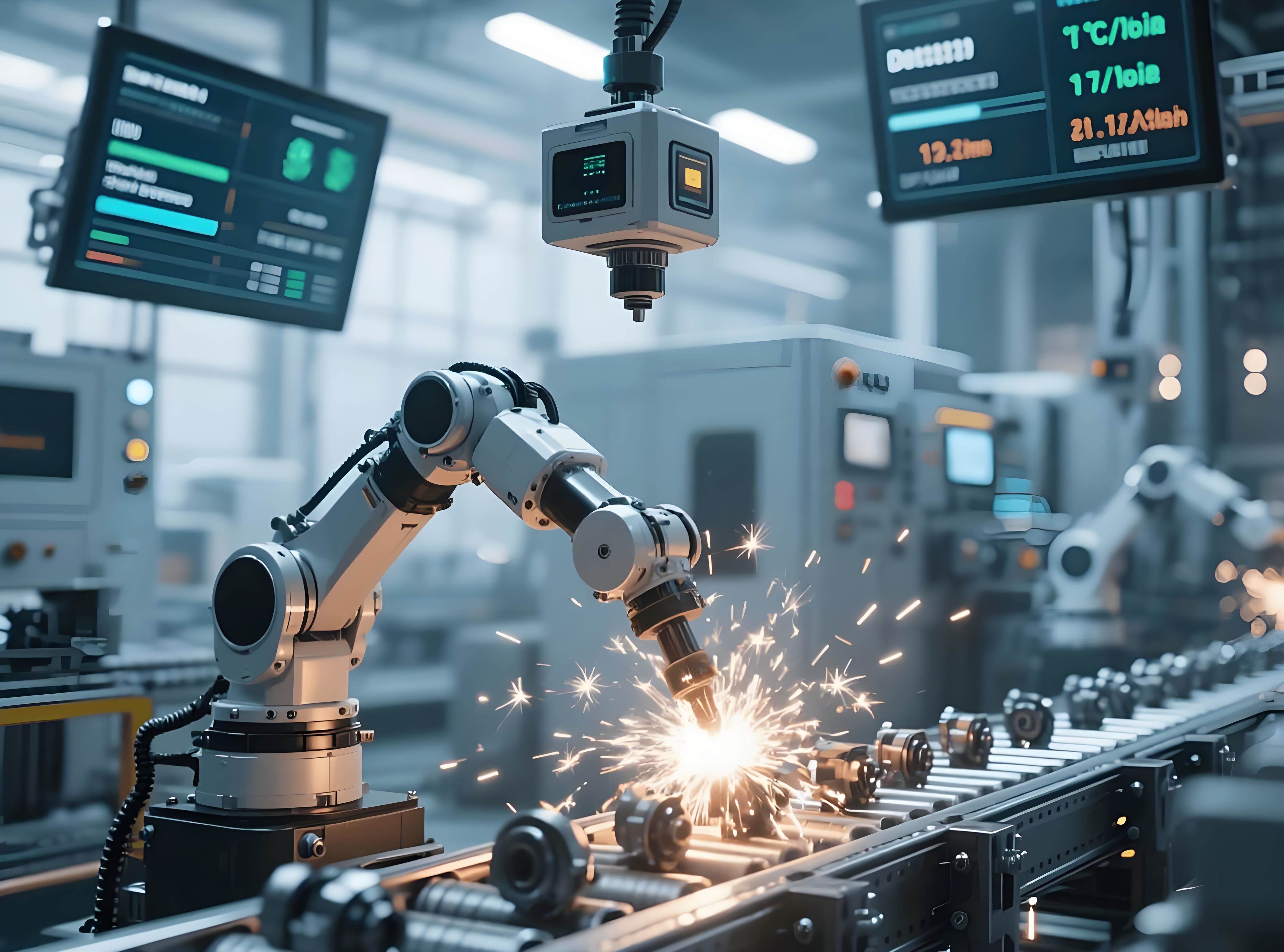
In Zhang's view, "Model-Data Resonance" is the key to breaking through current application bottlenecks. This initiative aims to create two categories of high-quality datasets—general industry knowledge and specialized industry knowledge—and to develop corresponding industry-specific large models and scenario-specific intelligent agents, forming a flywheel system where "data, models, and scenarios" mutually reinforce each other. He emphasized that industrial manufacturing is the main battlefield for shaping the new form of the intelligent economy. The digital and intelligent transformation of the manufacturing industry pushes upward for breakthroughs in high-end software and hardware technologies, spawns new business forms such as C2M customization and intelligent logistics downward, and serves as a "testing ground" for overcoming core technologies like explainable AI, digital twins, and edge computing.
Discussing the current state of high-quality industrial dataset construction in China, Zhang pointed out that the country has entered a new phase of systematic top-level design and pilot implementation in industrial manufacturing. As of the first quarter of 2026, over 116,000 high-quality datasets of various types have been built nationwide, with data volume exceeding 960 PB. In practical implementation, the "Model-Data Resonance" initiative, jointly promoted by the Ministry of Industry and Information Technology and the National Data Administration, has seen 516 institutions complete platform certification and 1,350 industrial datasets go online. Wuxi has built the country's first industrial-grade embodied intelligence dataset, while Tianjin and Shanghai have established specialized data factories. Nationwide, 73 industry chain leaders have taken the lead in building specialized datasets covering sectors such as power equipment and chemical drugs.
Zhang also candidly identified three core pain points currently facing the industry. First, there is a lack of standards for industrial data used in AI training, necessitating accelerated development of data standards and unified quality assessment specifications. Second, technologies for collecting, processing, and semantically recognizing unstructured data—such as processes, formulas, time-series data, and perception recognition—are still immature. Third, the development and utilization of industrial data remain in an early stage, with value anchors yet to be determined and no phenomenal application scenarios having emerged.
This article is compiled by Wedoany. All AI citations must indicate the source as "Wedoany". If there is any infringement or other issues, please notify us promptly, and we will modify or delete it accordingly. Email: news@wedoany.com