China's "Prefabricated Houses" See Global Orders Surge
en.Wedoany.com Reported - China's modular buildings have been gaining popularity in overseas markets recently. According to data from Shenzhen Customs, in the first four months of 2026, Chinese enterprises exported mobile houses worth 1.68 billion yuan via Shenzhen port, a year-on-year increase of 19.6%, with products sold to over 150 countries and regions worldwide. From design and R&D, intelligent production to ocean logistics and overseas installation, China is leveraging its full industrial chain advantages to turn "house building" into a standard industrial product export business.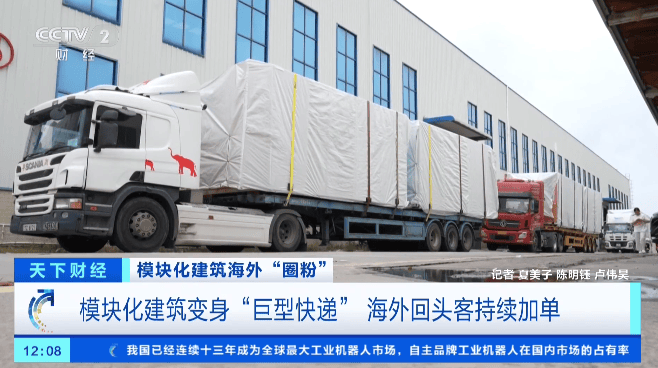
Modular construction is a building method that breaks down a structure into independent modules, manufactured in factories and then assembled on-site. It represents a higher degree of integration within prefabricated buildings. Data from the General Administration of Customs shows that from 2015 to 2025, China's export value of prefabricated buildings increased from $1.472 billion to approximately $4.339 billion, nearly tripling over the decade, with a growth rate of 45% in the first quarter of 2026. In the first four months of the year, the Guangzhou Customs district exported mobile houses worth 1.4 billion yuan, a year-on-year increase of 38.1%.
Continuous "repeat purchases" by overseas customers are the most direct recognition of "Made in China" construction. According to CCTV Finance, a British merchant purchased a Chinese-made modular elderly care apartment consisting of 63 modules. After being shipped from a Chinese factory and arriving at the Port of Southampton in the UK, on-site hoisting was completed in just two weeks. A merchant from Papua New Guinea purchased 84 building modules that traveled across the ocean for over a month and, upon arrival, became a fully functional hotel. A high-end elderly care apartment project in the UK, undertaken by CIMC Modular Building Systems, has also been officially shipped, providing nearly 80 age-friendly living units.
In addition to hotels, elderly care apartments, dormitories, and office buildings, the massive global construction of data centers has also boosted the popularity of domestic modular buildings overseas. A representative from Jiangmen CIMC Digital Energy Equipment Co., Ltd. stated that the demand for modular data center business is growing rapidly worldwide, with cumulative deliveries of modular prefabricated data center projects exceeding 1,000 MW of installed capacity, covering countries and regions including Malaysia, Indonesia, the Middle East, and Italy. CIMC Group provides global computing power clients with integrated "out-of-the-box" solutions covering design, construction, transportation, and delivery in the modular data center field. As of the end of the first quarter of 2026, the company has provided prefabricated data center technology and manufacturing delivery services for over 300 MW of AI and cloud computing clients.
At the CSCEC Hailong Intelligent Construction Industrial Park in Shenzhen, Guangdong, no scaffolding or dust is visible. A four-story vertical factory is busy with production, with an annual delivery capacity of approximately 20,000 to 30,000 modular buildings. Modular construction involves manufacturing ceilings, floors, water and electrical pipelines, and even bathroom waterproofing layers on an assembly line in the factory, which are then shipped overseas and assembled on-site like building blocks. Compared to traditional construction, the construction cycle for modular buildings can be shortened by over 60%, with precision control measured in millimeters.
According to market research institutions, the global modular building market size is expected to exceed $142.8 billion by 2030. As one of the world's largest construction markets, China's full industrial chain advantages are accelerating the transformation into export competitiveness. From design and R&D, intelligent production to ocean logistics and overseas installation, Chinese construction is "packaging" houses and selling them globally.