Samsung Electronics Mass-Produces First PCIe 6.0 Enterprise SSD
en.Wedoany.com Reported - Samsung Electronics announced on July 8 that it has begun mass production of its first enterprise solid-state drive (eSSD) based on PCI Express (PCIe) 6.0, the PM1763.
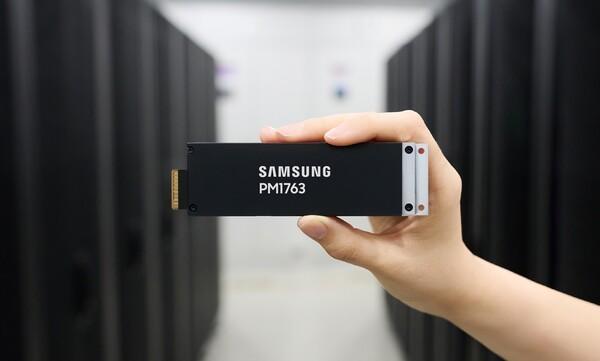
The PM1763 combines Samsung's ninth-generation V-NAND with the company's new 4nm PCIe 6.0 controller, making it the first product of its kind in this field. With faster read performance and an optimized controller architecture, this SSD aims to maximize data processing efficiency. The drive supports the NVMe (Non-Volatile Memory Express) 2.1 specification and is suitable for artificial intelligence (AI) data centers and server infrastructure. The PM1763 is available in three capacity options: 4TB, 8TB, and 16TB.
PCIe 6.0 uses four-level pulse amplitude modulation (PAM4) signaling, doubling data transfer bandwidth compared to PCIe 5.0. The sequential read and write performance of the PM1763 is twice that of its predecessor, the PM1753. The 16TB model achieves sequential read speeds of up to 28,400 MB/s and sequential write speeds of up to 21,900 MB/s. Based on Meta's Llama 3 70 billion parameter (70B) model, this speed is sufficient to transfer a 40GB large language model (LLM) in approximately 1.4 seconds. Higher throughput reduces data latency between AI accelerators and processors, thereby enhancing AI computing performance.
During AI training and inference, SSDs must transfer massive amounts of data—including AI model datasets and key-value (KV) cache data—to central processing units (CPUs) and graphics processing units (GPUs). Data transfer speed is critical for AI SSDs, as sustained data delivery is key to maintaining computing performance, response time, and quality of service. The PM1763 is optimized for next-generation liquid-cooled AI servers and supports direct-to-chip cooling (D2C), where cold plates are directly connected to key components to maintain sustained performance under heavy loads. Samsung stated that the new drive offers 1.8 times the energy efficiency of its predecessor, helping to reduce data center operating costs.
In terms of security features, the PM1763 supports post-quantum cryptography (PQC) algorithms to defend against future quantum computing attacks and complies with the TEE Device Interface Security Protocol (TDISP) standard for protecting data channels in virtualized environments. PQC is designed to address vulnerabilities of traditional encryption methods in the face of quantum computers, while TDISP is a security standard that prevents unauthorized access when allocating and connecting SSDs in virtualized environments.
Choi Jang-seok, Vice President of the Memory Product Planning Team at Samsung Electronics, stated that the PM1763 has successfully completed customer validation, meeting the requirements of global customers for next-generation AI platforms. He also noted that by expanding memory capacity, this drive will become a key solution to help customers operate AI models more efficiently.
Related Products





TWP16 P-Band Tropospheric Wind Profile Radar
China Huayun Meteorological Technology Group Co., Ltd.
Automatic Aiming Laser Remote Obstacle Removal Robot
Pinggao Group Weihai High-Voltage Apparatus Co., Ltd.


Multi-function Marine Monitoring Low-altitude Detection Radar Sea-air Boundary Ocean Dynamic Environment Measurement
Chengdu Dixin Technology Co., Ltd.
Mine Explosion-proof and Intrinsically Safe Industrial Ethernet Ring Network (10 Gigabit/Gigabit)
Chongqing Mas Sci&Tech Co., Ltd.
Comprehensive Mining Automation Control System
Beijing Tianma Intelligent Control Technology Co., Ltd.