Huawei ISC 2026 Introduces HPC+AI Data Infrastructure Solution
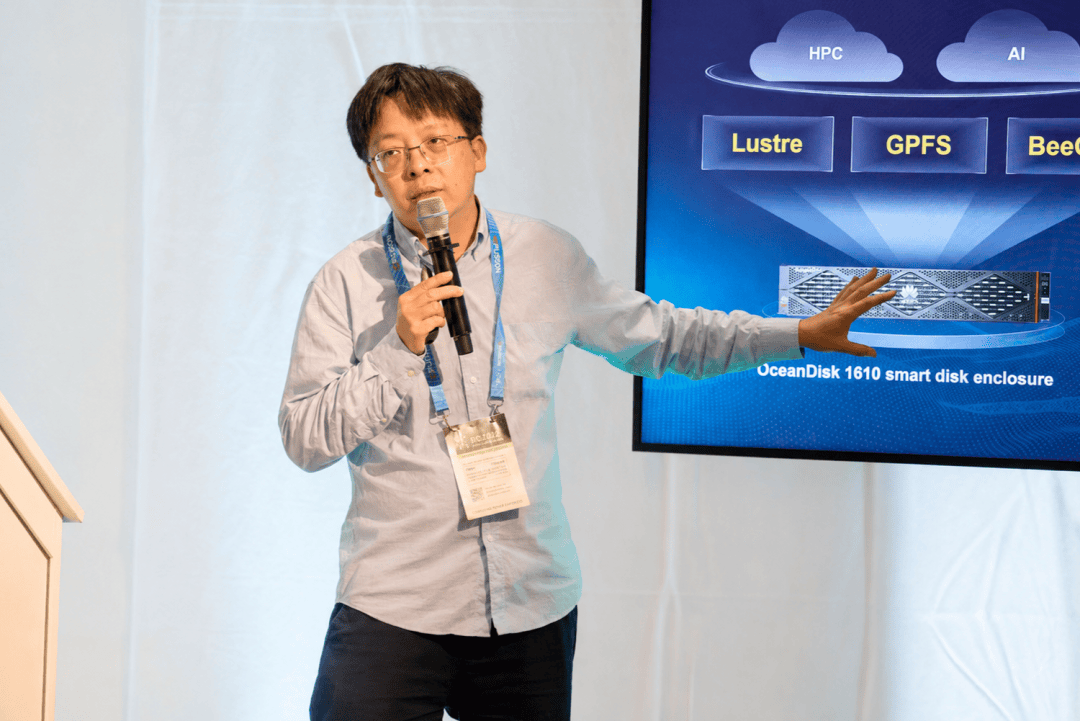
en.Wedoany.com Reported - During the ISC High Performance 2026 conference, Zheng Yong, Senior Architect of Huawei Distributed Storage, delivered a speech highlighting the accelerated integration of AI technology with High Performance Computing (HPC). As the scale, diversity, and mobility of scientific research data continue to grow, data infrastructure is becoming a key engine for unlocking data value and driving scientific innovation.
AI is profoundly transforming the paradigm of scientific research. From large model-assisted research to agent-driven innovation, the reliance of scientific research on data continues to intensify, with data exhibiting trends of multimodal integration and cross-domain sharing. At the same time, research organizations face two major challenges: first, the need to efficiently manage massive data at the PB or even EB level; second, the acceleration of AI-driven innovation imposes higher demands on data storage, governance, and circulation capabilities. To address these challenges, Huawei has built an end-to-end data infrastructure solution tailored for scientific HPC+AI convergence scenarios, helping research institutions unlock data value and accelerate innovation.
For scientific research data management, Huawei has launched the AI Data Lake solution, which is centered on the OceanStor Pacific all-flash distributed storage. With a high capacity density of 11PB/2U, it achieves optimal TCO (Total Cost of Ownership) and can store massive amounts of data. The solution integrates the DME Omni-Dataverse unified data space, supporting real-time data ingestion into the lake for multimodal and cross-site data, along with global visibility and manageability. It also features second-level retrieval capabilities for hundreds of billions of vectors with thousands of dimensions, accelerating the aggregation, mining, and supply of high-quality data. Combined with an open AI toolchain, this solution further enhances the efficiency of unstructured data governance, providing a data foundation for AI innovation.
For scientific high-performance computing, Huawei has built a converged HPC+AI data foundation. In HPC and AI training scenarios, the OceanDisk 1610 intelligent disk enclosure serves as the optimal storage foundation for parallel file systems, seamlessly integrating with file systems such as BeeGFS and Lustre. It delivers 220GB/s bandwidth and a high capacity density of 4PB/2U, efficiently supplying training data while reducing data center space and energy costs. In AI inference scenarios, Huawei has introduced the "3+1" AI data platform, which integrates a knowledge base, KV Cache pool, and memory pool. Using UCM inference memory data management technology, it achieves over 95% high-precision knowledge retrieval. For ultra-large-scale inference clusters, Huawei has launched the CMS (Context Memory Storage) and the DPU-based OceanDisk 1800 intelligent disk enclosure, supporting native KV semantics and xPU direct access capabilities. This builds a PB-level shared KV Cache pool, significantly improving cache hit rates, reducing first Token latency by 90%, and comprehensively enhancing inference efficiency.
In the future, Huawei will continue to focus on data storage, data governance, and AI-driven data utilization, helping global research institutions unlock data value and accelerate scientific innovation.
Related Products


Comprehensive Mining Automation Control System
Beijing Tianma Intelligent Control Technology Co., Ltd.
TWP16 P-Band Tropospheric Wind Profile Radar
China Huayun Meteorological Technology Group Co., Ltd.
Multi-function Marine Monitoring Low-altitude Detection Radar Sea-air Boundary Ocean Dynamic Environment Measurement
Chengdu Dixin Technology Co., Ltd.

Flat Portable Satellite Terminal 0.35m Aperture Manual Portable Terminal
China Starwin Science & Technology Co., Ltd.

Mine Explosion-proof and Intrinsically Safe Industrial Ethernet Ring Network (10 Gigabit/Gigabit)
Chongqing Mas Sci&Tech Co., Ltd.