en.Wedoany.com Reported - KAIST (President Bae Choong-sik) announced on July 20 that a research team led by Professor Il-Kwon Oh from the Department of Mechanical Engineering has developed a photothermal-driven ultra-deformable structure. Using a single ultraviolet laser process, the team enabled a flat nickel-titanium shape memory alloy (SMA) sheet to bulge from a plane into a three-dimensional shape under light exposure.
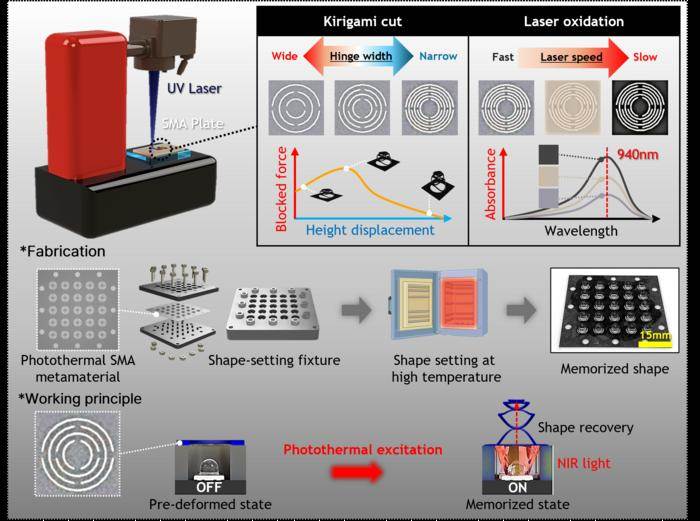
Next-generation wearable devices and soft robots require both thinness and lightness, along with the ability to change shape when needed. Such technologies are considered foundational for shape displays, adaptive surfaces, wearable interfaces, and soft robots. The research team designed precise cutting and folding patterns on a flat metal sheet, enabling it to transform into predetermined three-dimensional shapes, with the design principle based on the art of kirigami.
Shape memory alloys are special metals that, even after deformation, return to a preset shape when heated to a specific temperature. Due to their light weight and ability to generate significant force, they are widely used as key materials for soft robots and wearable actuators. However, conventional photothermal shape memory alloy actuators face a limitation: the surface of nickel-titanium alloy (NiTi) does not effectively absorb near-infrared light. To compensate for this, a separate light-absorbing coating, such as graphene oxide, polymer composites, or titanium nitride (TiN) films, is typically required. These external coatings may peel off during repeated operation, require additional processing, and can increase thermal capacity, slowing response speed, thereby imposing limitations on both manufacturability and actuation performance.
To address this issue, the research team employed ultraviolet laser micromachining to form kirigami structures on thin shape memory alloy (SMA) sheets, while simultaneously generating a micro-nano porous titanium oxide (TiOₓ) layer on the surface through laser-induced oxidation. As a result, the absorption rate of near-infrared light was significantly enhanced without any separate external coating. The team also achieved a platform that allows precise control of the height of three-dimensional deformation and the resulting force output by adjusting structural parameters such as hinge width and slit width. The core of the research lies in simultaneously programming the mechanical deformation mode and light absorption efficiency into a single metal structure.
Additionally, the team applied a spatial patterning technique to control the degree of laser-induced oxidation. Different regions could deform sequentially at varying speeds under uniform light exposure of the same intensity. The researchers described this as "spatiotemporal actuation control," meaning the order and timing of deformation are directly encoded into the material itself through light absorption properties, without any separate electronic control.
The research team further integrated the photothermal SMA metastructure with a multi-channel near-infrared (NIR) LED array, expanding it into a three-dimensional shape display and tactile interface. Each SMA kirigami unit moved independently based on selectively applied light. Using this, the team successfully displayed the letter sequence K→A→I→S→T and achieved tactile navigation signals indicating directions.
Professor Il-Kwon Oh stated that this laser programming technology is a manufacturing-friendly platform that encodes both mechanical deformation and optical properties into a single metal structure without any separate coating process. This technology can be widely applied to next-generation light-controlled smart deformable interfaces such as adaptive surfaces, interactive tactile systems, and photothermal soft robots. Master's student Hyunsoo Kim from the Department of Mechanical Engineering is the first author, and Professor Il-Kwon Oh is the corresponding author. The research findings were published in the international journal Advanced Science and selected for the inside back cover of Volume 13, Issue 31, published on June 4, 2026.