en.Wedoany.com Reported - On July 22, with the precise anchoring and stable positioning of the final catenary wire outside the Changbei Airport Station on the Nanchang-Jiujiang High-Speed Railway, the installation of 334.2 track-kilometers of catenary wires was successfully completed. This marks the full completion of the main overhead network structure for the traction power supply system of the Nanchang-Jiujiang High-Speed Railway, paving the way for subsequent static acceptance and integrated commissioning and testing.
Catenary wires are the core of the "four electrical systems" in high-speed railways, serving as the sole dynamic current collection facility for high-speed trains. The construction precision must reach the millimeter level. EMUs rely on the dynamic contact between the pantograph on the roof and the contact wire to continuously draw power. The rated tension, height, stagger, and straightness of the contact wire directly affect the operational safety of high-speed trains.
The entire catenary installation process utilized constant-tension stringing vehicles. By monitoring in real-time and dynamically adjusting construction parameters, the straightness error of the contact wire was precisely controlled within 0.1 millimeters. To ensure the quality of catenary installation, the construction team relied on an intelligent dispatch command platform and BIM technology. By conducting risk assessments across the entire line and optimizing wiring paths, they effectively resolved challenges such as multi-disciplinary cross-construction and overlapping wire interference.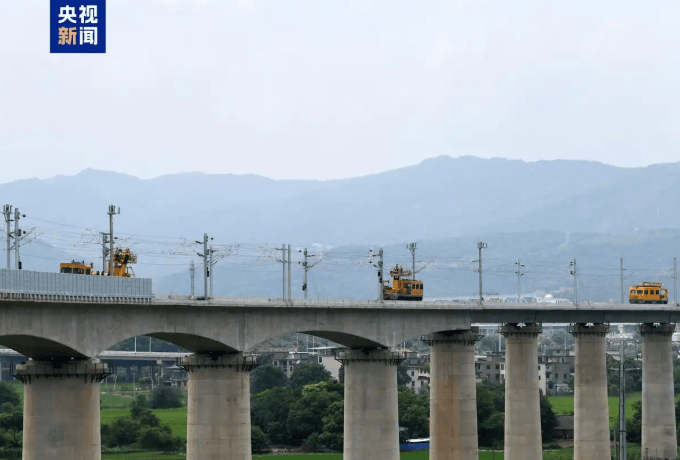
Shi Chaojun, Project Manager of the Nanchang-Jiujiang Project Department of China Railway Wuhan Electrification Bureau, stated that to complete the catenary installation task on schedule, the project team repeatedly organized technical personnel to survey the site, continuously optimized construction plans, and refined process procedures. Relying on a fully automatic cantilever pre-assembly platform, they carried out intelligent and unmanned pre-assembly construction, standardized the assembly of cantilevers along the entire line, and strictly controlled construction quality.
"After the completion of the entire catenary installation, the next steps will sequentially enter the static acceptance and integrated commissioning and testing phases. Once the line is operational, the railway travel time from Nanchang to Jiujiang will be reduced from the current one hour to as fast as half an hour," introduced Yu Yu, Deputy Commander of the Nanchang-Jiujiang Command of the Nanchang-Jiujiang Intercity Railway Company.
The Nanchang-Jiujiang High-Speed Railway is a key component of the Beijing-Hong Kong (Taipei) corridor, one of the main "eight vertical and eight horizontal" high-speed railway channels in China's "Mid- to Long-Term Railway Network Plan." Once completed and operational, it will further improve the national high-speed railway network layout, strengthen connectivity between the urban agglomerations in the middle reaches of the Yangtze River and those in the Yangtze River Delta, Guangdong-Hong Kong-Macao Greater Bay Area, and other regions. This is of great significance for promoting the development of the Yangtze River Economic Belt, enhancing the level of regional transportation infrastructure in Jiangxi Province, and supporting high-quality economic and social development along the route.