en.Wedoany.com Reported - At the rice paddies of Leigong Island in Yangzhong City, Zhenjiang, Jiangsu Province, the "Air-Ground Collaborative Autonomous Refilling Operation Platform" developed by Professor Ding Shihong's team from the School of Electrical and Information Engineering at Jiangsu University has completed key functional validation. The system consists of two spraying drones, one refilling unmanned ground vehicle (UGV), and a unified intelligent ground station. During on-site commissioning, the drones landed precisely on the UGV and automatically refilled with pesticide, requiring no human intervention throughout the entire process.
Drone-based crop protection operations have long faced the pain points of rapid pesticide depletion and frequent return trips for refilling. A drone often needs to return within less than ten minutes of takeoff, with round trips taking over a dozen minutes, and when multiple drones operate simultaneously, pilots are overwhelmed. Professor Ding Shihong likens this system to a mobile "support vehicle" for drones—the drones simply fly, while the UGV takes position in advance along field roads. When pesticide levels run low, the system automatically calculates the optimal landing point, the drone flies to the vehicle for precise landing and automatic refilling, then takes off again to continue operations.
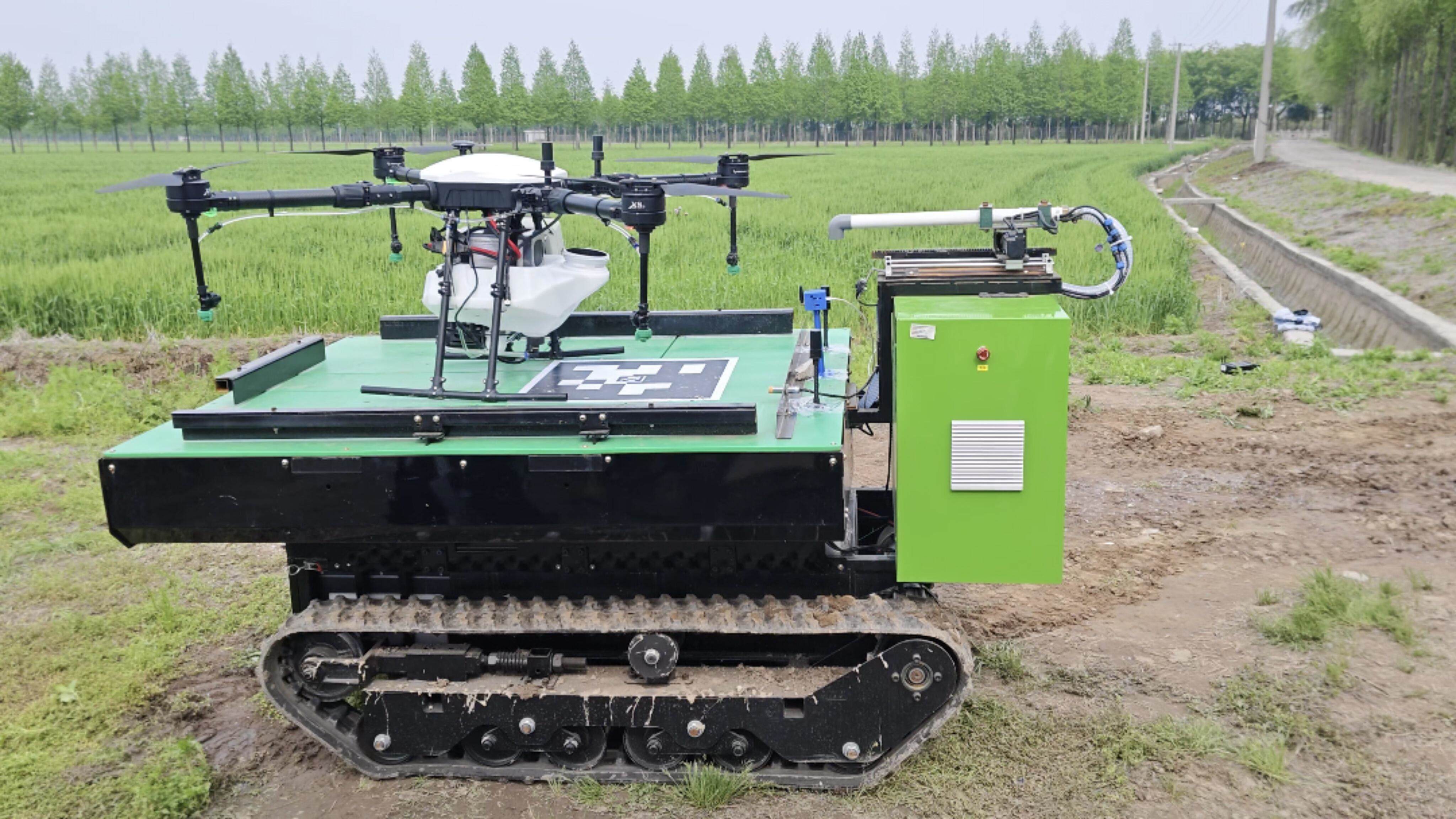
The core challenge in system integration lies in unifying all equipment control programs within a single system, enabling one "brain" to manage everything. To address the real-time communication issue between drones and the UGV separated by hundreds of meters, the team configured a "digital mirror" for each device on the host computer, functioning as a backend simultaneous translation machine. When a drone's pesticide runs low, the host computer immediately detects it and dispatches the UGV to the optimal rendezvous point. Compared to communication, precise landing is even more challenging. The drone must rely on QR code visual guidance to land on the moving vehicle. In traditional approaches, once the drone descends, the QR code exits the camera's field of view, causing frequent recognition failures. The team adopted a design of a large code nested with a small code: when the large code completely exits the field of view, the small code occupies the center of the frame. Through smooth switching between the two codes, from several meters altitude to the moment of touchdown, landing deviation is controlled within 10 centimeters, significantly improving the success rate.
To accelerate the transition of laboratory results into practical applications, the team established a validation center on the farm. To address the issue of drone route deviation caused by wind fields in hilly and mountainous areas, the team applied their independently developed generalized super-twisting sliding mode control algorithm to path tracking. Field test data show that the drone's straight-line tracking error is controlled within ±10 centimeters, while the UGV's straight-line path tracking accuracy remains stable within ±5 centimeters. During field tests at Leigong Island Farm last year, the team identified over a dozen issues, including excessive UGV turning errors, scratched QR codes, and intermittent communication disruptions. By consulting local farmers and agricultural machinery operators, they reduced the UGV's turning accuracy to within 30 centimeters and switched to laser-engraving the QR code onto the vehicle's body surface.
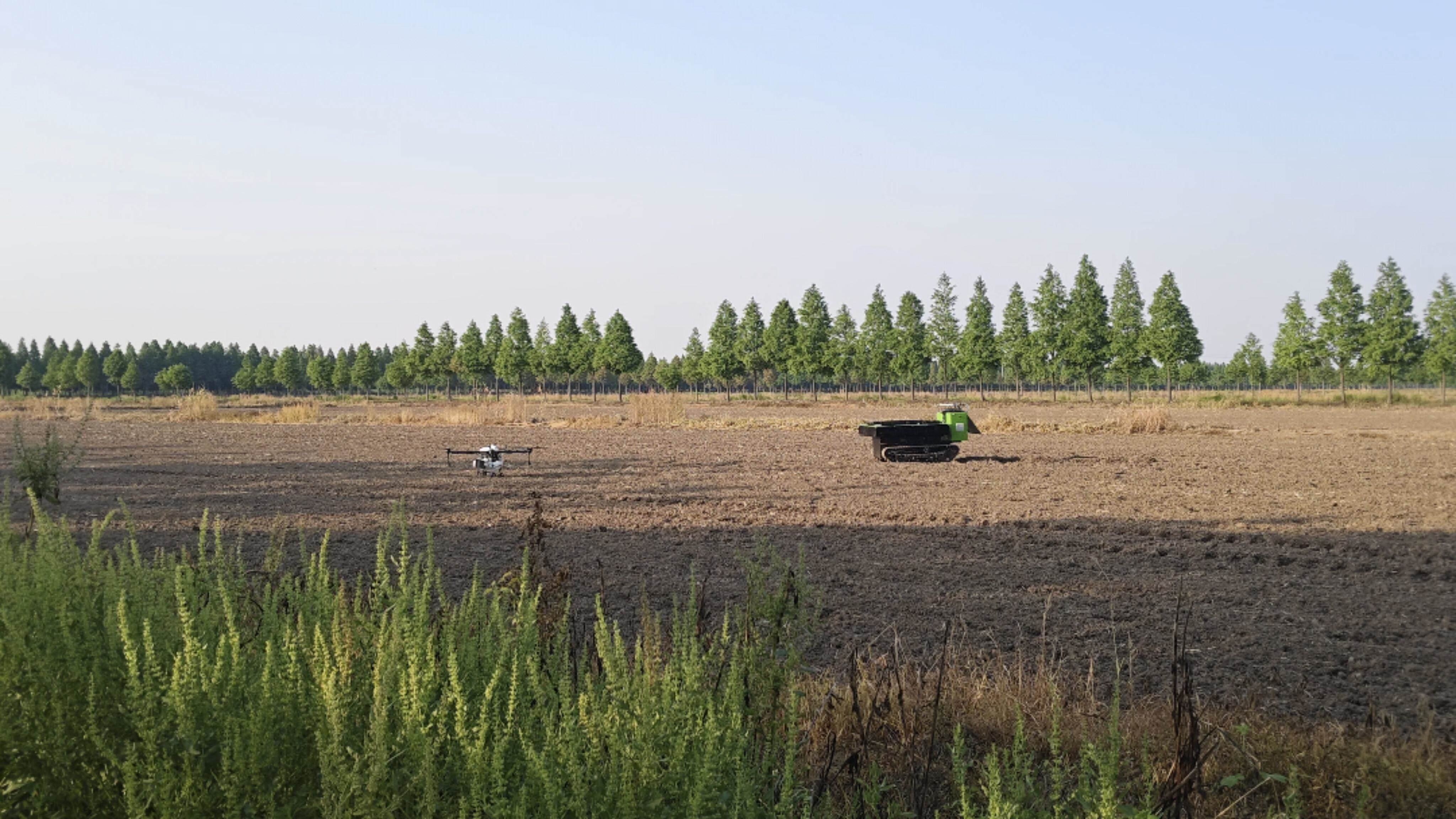
Continuous field test results show: the optimal operation path automatically planned by the host computer eliminates the need to hire experienced drone pilots, reducing daily operating costs by approximately 200 yuan; path repetition rate drops from 10%–15% for experienced pilots to below 5%; the time for a single drone refill is compressed from 5 minutes to under 2 minutes, doubling effective operation time; one refilling UGV can simultaneously serve two spraying drones, allowing pilots to complete an entire operation cycle without manual refilling. The team stated that in the future, it may be possible for one person to manage more than ten air-ground collaborative operation units from a backend station.
Beyond crop protection operations in mountain orchards, tea gardens, and oil-tea camellia forests, this technology can also be transferred to scenarios such as photovoltaic panel cleaning, power line inspection, and material transport in mountainous areas, with companies already in contact for cooperation and commercialization. Ding Shihong noted that agricultural crop protection drones account for over 98% of all drone flight time nationwide, and deep engagement with this application scenario constitutes substantive support for the low-altitude economy.