Brazilian Operators Accelerate Network Investment to Tackle Fivefold Surge in AI Traffic
en.Wedoany.com Reported - Artificial intelligence (AI) is rewriting the direction of internet traffic. In the past, operator networks were dominated by streaming and downloads, with data flowing from data centers to user devices; in recent months, this direction has begun to reverse at an accelerating pace—demand for real-time generation of images, videos, and text is driving massive amounts of data to be uploaded from phones and computers to the cloud. Brazilian telecom operators must invest in upgrading their networks to adapt to this new traffic logic.
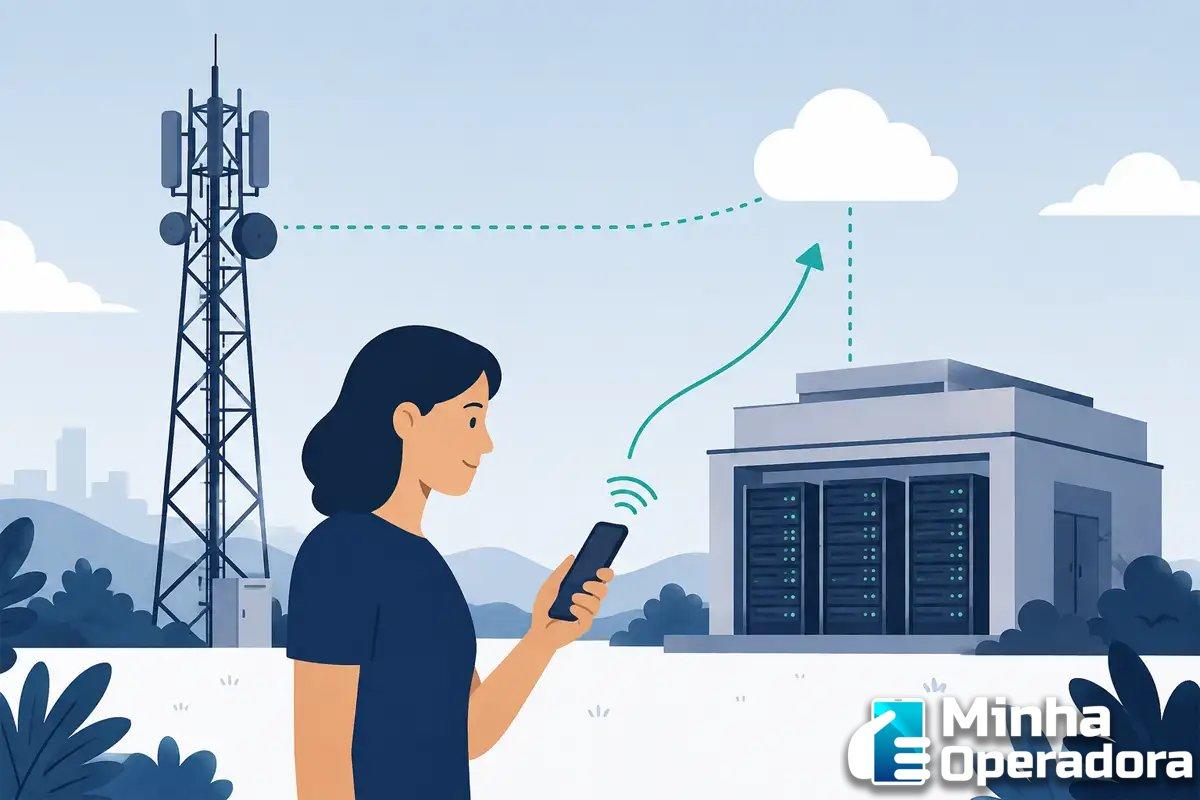
By the early years of the next decade, traffic on this data path flowing from devices to the cloud is expected to grow fivefold, with 25% of it generated directly by AI agents. Research from U.S. consulting firm Ookla shows that only 5.74% of Brazil's mobile network capacity is allocated to the uplink—the channel through which users send data to the internet—while countries such as Indonesia, Germany, Thailand, Sweden, and Norway have ratios close to 24%. Brazil's transmission capacity is less than a quarter of that of global leaders, and Ookla ranks the country among those least prepared for the new traffic structure.
On the investment front, industry group Conexis estimates this year's investment at around R$36 billion, while experts view the situation as challenging and expect investment to remain stable in the coming years. Standalone 5G networks (stand alone), which support high-speed operation of AI applications, account for only 10% of Brazil's total 5G infrastructure.
Rodrigo Dienstmann, President of Ericsson for the Southern South America region, stated that as "physical AI" enters daily life, wearable devices, drones, and cars will continuously exchange data with networks, and AI products will send commands to networks through agents, driving traffic growth. He also noted that AI agents will keep networks in use around the clock, eliminating idle hours in the early morning; operators will need to reconfigure frequencies, reallocate 3G and 4G spectrum to 5G, and increase the number of base stations to enhance network density.
Andre Gildin, a partner at consulting firm RKKG, analyzed that countries leading in network rankings are already optimizing their architectures by combining AI-oriented 5G deployments with fiber-optic connections between operators and cloud service providers. One of Brazil's current bottlenecks is that data centers are concentrated in São Paulo, making latency challenges between mobile networks and major cloud providers prominent; long or poorly optimized paths to the cloud slow down AI application responses. He recommends expanding spectrum and accelerating the adoption of standalone 5G.
Mike Dano, Principal Analyst for the telecom industry at Ookla, believes the biggest challenge facing operators is economic: reversing decades of prioritization of download traffic comes at a cost, and excessively high costs could dampen consumer adoption of advanced AI services.
Brazil's 5G rollout is still expanding. Data from consulting firm Teleco shows that Brazil has 276.4 million mobile subscriptions, with 5G accounting for 23.9%, 4G for 64.3%, and 3G for 5.1%; 5G networks cover 3,040 of the 5,570 municipalities, while 4G covers all 5,570.
Marcos Ferrari, Executive President of Conexis, stated that telecom operators have already noticed this trend, and it is irreversible. Ookla data indicates that as AI usage increases, Brazilian users will experience slower networks during peak consumption hours, with latency rising by up to sevenfold, directly impacting applications sensitive to response times.
Operators have already begun adjusting. Claro's Chief Technology Officer, André Sarcinelli, said that AI application performance depends on the integration of telecom infrastructure with the cloud ecosystem, and the company has positioned itself as a "neocloud," investing R$1 billion to expand its platform. Vivo's Guilherme Silveira noted that the operator invests R$9 billion annually in 5G and fiber expansion. TIM Brasil's Vice President of Technology, Marco Di Costanzo, said the company has accelerated infrastructure modernization since last year, adopting AI-controlled antennas that automatically adapt to traffic; the São Paulo project has been completed, with plans to expand to eight other capital cities this year.
Silveira believes operators play a fundamental role in connectivity, but investments from cloud providers, data centers, hyperscalers, and application developers are equally critical. Experts judge that building the AI ecosystem requires ongoing collaboration between telecom operators and major technology companies.
Related Products

TWP16 P-Band Tropospheric Wind Profile Radar
China Huayun Meteorological Technology Group Co., Ltd.


Comprehensive Mining Automation Control System
Beijing Tianma Intelligent Control Technology Co., Ltd.
GYTA Type Non-Self-Supporting Aerial/Duct Optical Cable
TONGDING INTERCONNECTION INFORMATION CO., LTD.

Hot Selling 10 Inch Intel N5100 I5 I7 FHD 8 +128GB 16+256GB Win10 Pro Win11 Pro 4G 5G Rugged Tablet PC Pad with NFC Barcode
Highton Electronics Co., Ltd.

Automatic Aiming Laser Remote Obstacle Removal Robot
Pinggao Group Weihai High-Voltage Apparatus Co., Ltd.
Multi-function Marine Monitoring Low-altitude Detection Radar Sea-air Boundary Ocean Dynamic Environment Measurement
Chengdu Dixin Technology Co., Ltd.