Spain's Navarra to Host €100 Million Wooden Wind Turbine Blade Plant, Operational by 2031
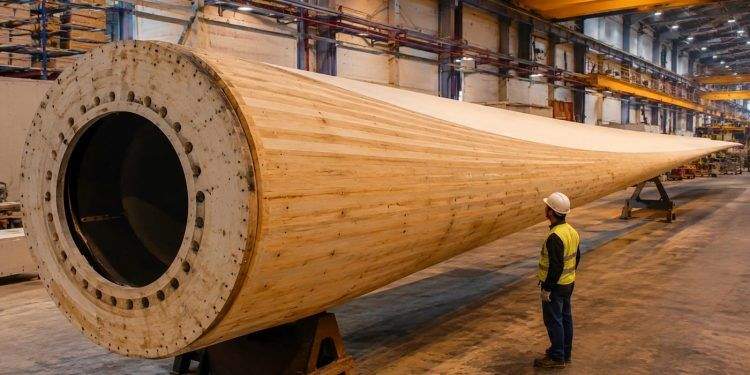
en.Wedoany.com Reported - German companies Voodin Blade Technology and Anker-Tec, together with Lithuanian firms VMG Wood Invest and VMG Technics, have formed a consortium to build a commercial factory producing wind turbine blades from laminated wood, with Navarra as a potential site. The project has a budget of €100 million, of which €48.18 million comes from the EU Innovation Fund. It is expected to become operational in 2031 and create around 450 jobs.
As wind power installed capacity continues to grow, so does the pressure to handle decommissioned wind energy equipment. Blades are typically made of fiberglass or carbon fiber combined with epoxy resin, a hybrid structure that is difficult to separate and reuse. With a service life of approximately 20 to 25 years, some decommissioned blades end up in landfills. Industry estimates suggest that the cumulative global volume of decommissioned blades could reach 43 million tonnes by 2050.
The consortium plans to replace traditional composite materials with LVL (Laminated Veneer Lumber). LVL is produced by pressing multiple layers of Nordic spruce veneers with adhesives, offering sufficient mechanical strength and dimensional stability while reducing the use of fiberglass, carbon fiber, and plastics. While the industry has previously explored mechanical, thermal, and chemical recycling methods, no combination has yet emerged that is both cost-effective and widely scalable in terms of price and performance.
Between 85% and 90% of a wind turbine's total mass can already be routinely recycled. WindEurope, the European wind energy industry association, classifies steel, copper, and electronic components within this range as recyclable materials. Blades, however, are excluded from routine recycling because the resin matrix firmly bonds all components together, making them difficult to dismantle. Austria, Finland, Germany, and the Netherlands have already banned decommissioned blades from landfills. Although the industry has made voluntary commitments to avoid landfilling, there is no unified mandatory regulation across Europe.
The rationale behind the wood-based approach is to reduce downstream processing challenges at the manufacturing stage, rather than adding recycling processes after blades are decommissioned. As installed wind turbines progressively reach the end of their service lives, finding viable recycling pathways for these components has become increasingly urgent.
The project's figures of a 78% reduction in emissions and a 20% decrease in costs should be regarded as corporate estimates rather than independently certified results. Furthermore, there is still a lack of independent test data comparing wooden blades with fiberglass or carbon fiber blades over decades of use. Whether wooden blades can maintain their design strength, cost advantages, and environmental performance over the long term remains to be verified once the factory enters stable production.