
A new study led by researchers from the International Food Policy Research Institute (IFPRI), published in the Journal of Cleaner Production, proposes a novel approach to sustainable agricultural intensification with positive implications for food security and land conservation in Senegal. The framework is applicable to other countries facing similar challenges.
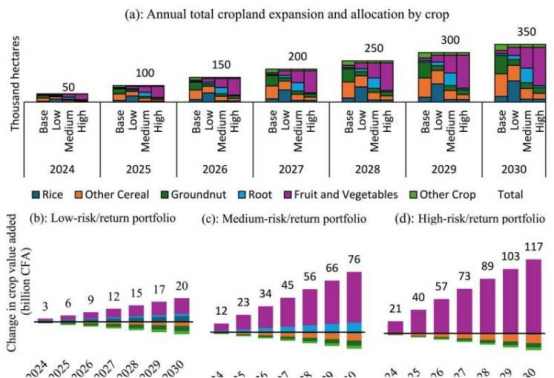
Over the past two decades, rapid cropland expansion in developing countries has accelerated deforestation and biodiversity loss. Despite productivity gains, many nations still rely on expanding farmland to meet rising food demand.
In Senegal, the study finds that redirecting cropland expansion toward high-value crops such as fruits and vegetables could reduce additional land conversion needs by up to 68% by 2030. Currently, Senegal's farmland allocation is heavily skewed toward low-risk, low-return staple crops, falling below the "efficient frontier" (the benchmark for optimal agricultural investment allocation). The research shows that this shift would boost GDP, reduce poverty, improve dietary diversity, and minimize emissions and water use.
Lead author and IFPRI Senior Scientist Angga Pradesha, a PhD candidate at Humboldt University of Berlin, noted that smarter, more diversified farmland investments can deliver better national outcomes without requiring additional inputs or new technologies. This offers a practical alternative to conventional land-sparing and land-sharing strategies by progressively achieving land sparing through better use of existing resources.
Co-author Khalid Siddig, IFPRI Senior Research Fellow and leader of the Sudan Strategy Support Program, highlighted the study's unique integration of portfolio theory with a computable general equilibrium model. This approach evaluates trade-offs in agricultural investment while capturing real-world market dynamics, providing policymakers with a powerful tool to assess the impacts of different cropland allocation scenarios on farmers, the broader economy, and the environment.
The study urges policymakers to adopt a whole-economy perspective when planning agricultural investments, incorporating risk, returns, and inter-sectoral linkages. Targeted support measures — such as infrastructure expansion, improved credit access, and other risk-reducing initiatives — can help farmers, especially smallholders, overcome risk aversion and adopt higher-risk, higher-return crop portfolios.
James Thurlow, Director of IFPRI's Foresight and Policy Modeling Department and co-author, emphasized that while the study focuses on Senegal, the developed framework can be applied to other countries facing similar pressures from cropland expansion and food demand. It offers governments a practical method to progressively improve food security and sustainability through smarter land-use decisions based on crop risk and return profiles.