
The ultra-realistic humanoid robot artist Ai-Da, while unveiling a new portrait of King Charles, explained the inspiration behind this richly layered and structurally complex work to the outside world and explicitly stated that she has no plans to "replace" humans.
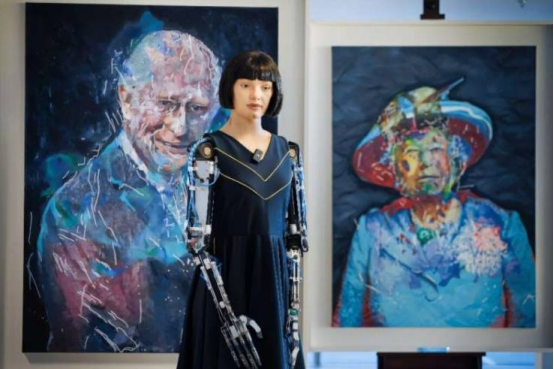
Ai-Da is considered one of the most advanced robots in the world. Designed to resemble a human female, she has an expressive and lifelike face, large hazel eyes, and a brown bob haircut. However, her arms feature obvious mechanical elements, with exposed metal that can be swapped out depending on the form of artistic creation.
In terms of artistic achievements, Ai-Da has an impressive record. Late last year, her portrait of British mathematician Alan Turing became the first artwork by a humanoid robot to be sold at auction, fetching over $1 million. Regarding her latest oil painting, "Algorithm King," Ai-Da believes its value cannot be measured in money. "My artworks are intended to serve as catalysts for discussions on the ethical aspects of new technologies," Ai-Da said in an interview with AFP at the UK diplomatic mission in Geneva, where King Charles's new portrait will also be housed. Speaking in a slow and deliberate tone, she emphasized that the purpose of creation is "to foster critical thinking and encourage responsible innovation for a fairer and more sustainable future."
During the United Nations Summit on AI for Good, Ai-Da—who excels in sketching, painting, and sculpture—detailed the methods and inspiration behind her creations. "When creating artworks, I employ various AI algorithms. I start with a basic idea or concept I want to explore, then consider the purpose of the art and what the work aims to convey." Ai-Da also noted that King Charles has used his platform to raise awareness about environmental protection and interfaith dialogue, and creating this portrait was a way to express respect, hoping that King Charles would appreciate her efforts.
Ai-Da was created in 2019 by a team led by contemporary art expert Aidan Meller, in collaboration with AI specialists from Oxford University and the University of Birmingham. Aidan Meller told AFP that this humanoid robot, named after the world's first computer programmer Ada Lovelace, is an ethical art project and not intended "to replace painters"—a view Ai-Da agrees with.
Ai-Da acknowledges that AI is profoundly transforming human creative expression, including in the art world, but firmly believes that "AI or my works will not replace human artists." Instead, the goal is "to inspire audiences to think about how to positively utilize AI while recognizing its risks and limitations." When asked whether machine-created paintings can be considered art, Ai-Da confidently stated: "My works are unique and creative. Whether humans recognize them as art is an important and interesting topic."