
Generative artificial intelligence (AI) holds the potential to revolutionize fashion design. By recognizing patterns in data and generating new text and images, deep learning-based AI models can assist fashion designers in developing new product catalogs, expanding creativity, increasing efficiency, and bringing products to market faster.
Large language models (LLMs) such as ChatGPT and AI image generators such as DALL-E have already shown impressive results across many industries and are driving the adoption of AI. In the fashion field, LLMs can help designers—and even non-professionals—understand past styles and predict future fashion trends. These insights can then be used to create prompts for AI image generators, producing actual fashion collections. Therefore, understanding how to effectively integrate AI into fashion is becoming increasingly important.
In a recent study, Professor Yoon Kyung Lee from the Department of Clothing and Textiles at Pusan National University in Korea, together with master’s student Chaehi Ryu, explored how generative artificial intelligence can help visualize seasonal fashion trends.
“To effectively apply artificial intelligence in fashion, we must understand the characteristics of generative AI models and make informed judgments about their application areas,” explained Professor Lee. “In this study, we explored how to use effective prompt engineering techniques to generate realistic fashion collection images through AI.” The research results were published on June 22, 2025, in the Clothing and Textiles Research Journal.
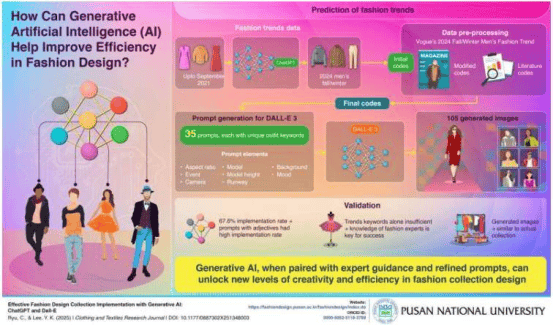
The researchers first used ChatGPT-3.5 and ChatGPT-4 to analyze men’s fashion trends based on historical data up to September 2021. Building on this analysis, they further used ChatGPT to predict men’s fashion trends for Fall/Winter 2024. The design elements from these predicted trends were categorized as “initial codes.”
In addition, design elements from Vogue’s Fall/Winter 2024 men’s fashion trend data were used as “revision codes,” and design elements from fashion design concept literature were used as “literature codes.” These elements were then analyzed and reorganized into six final codes: trends, silhouette elements, materials, key items, garment details, and decorations.
Using these codes, they created 35 prompts for DALL-E 3, each describing a unique outfit. The prompts followed a unified template: a male model walking the runway at a 2024 Fall/Winter fashion show. This template allowed customization of various details of real fashion show events, including aspect ratio, event, camera angle, model appearance and height, runway design, background, audience details, and atmosphere. Each prompt was run three times, generating a total of 105 images.
DALL-E 3 executed the prompts perfectly with an accuracy rate of 67.6%. Specifically, prompts containing adjectives showed extremely high execution rates. Some images in the generated collections were remarkably similar to actual 2024 Fall/Winter men’s fashion collections. However, some errors also appeared—most images leaned toward ready-to-wear styles, and DALL-E struggled to incorporate trending elements such as gender fluidity. Relying solely on trend keywords was insufficient to generate accurate results, indicating the need for further learning.
Professor Lee noted: “Our findings show that professionally worded prompts are crucial for the precise application of generative artificial intelligence in fashion design, highlighting the important role of fashion experts. With further learning and improvement, generative AI models like DALL-E 3 will help fashion designers create entire collections more efficiently, support their creativity, and help non-professionals understand fashion trends.”
Overall, this demonstrates that generative artificial intelligence is not only suitable for professionals but also for the general public, enabling people to explore, predict, and design the fashion of upcoming seasons more easily than ever before.