
Quantum computers show enormous potential in solving optimization and data processing problems that are intractable for classical computers. Currently, many promising quantum computing platforms are built on superconducting qubits. However, scaling up and deploying superconducting quantum processors still faces significant challenges, such as crosstalk between qubits due to frequency crowding, and difficulties in simultaneously controlling or measuring multiple qubits.
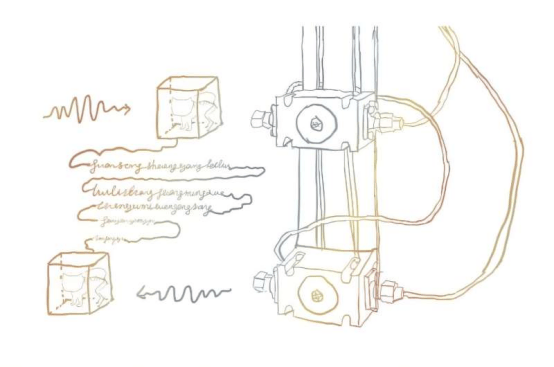
To address these issues, physicists and engineers are actively exploring distributed quantum computing architectures, which connect multiple small processors to build larger systems. The key to this approach is establishing entangling gates that enable quantum mechanical interactions between two or more qubits located on different chips. Researchers from the Beijing Academy of Quantum Information Sciences and the Chinese Academy of Sciences recently reported in Physical Review Letters a method to successfully create high-fidelity entangling gates between two superconducting quantum processors separated by 30 centimeters.
“This work originated from a question posed by Dr. Yan Fei last year: Is it possible to realize a two-qubit entangling gate between two remote quantum chips?” said co-author Professor Zhang Wengang. The research team utilized the cross-resonance effect and implemented two-qubit entangling gates—including the widely used CNOT and CZ gates—through a microwave cavity formed by a linear resonator and a long microwave cable. Professor Zhang noted: “This work demonstrates for the first time direct two-qubit gates with such high fidelity between different quantum chips. The implementation is simple, requiring no additional qubits or control lines, and will become a key building block for distributed quantum computing.”
The study not only opens a new path for distributed quantum computing but also foreshadows broad prospects for future quantum information processing. Professor Zhang and his team plan to fabricate larger chips containing approximately 100 qubits and realize entanglement between them, ultimately advancing toward the goal of distributed quantum computing. At the same time, they are exploring plug-and-play technologies to allow more flexible chip replacement and improve system practicality.