
Astronomers from Wuhan University in China used the Insight-HXMT (Hard X-ray Modulation Telescope) satellite to observe a major outburst of the X-ray binary RX J0440.9+4431 that occurred approximately three years ago. The observation results were published on the preprint server arXiv on July 24, providing rich data for a deeper understanding of the system's properties and behavior. X-ray binaries are a class of binary star systems that emit X-rays, formed by mass transfer from a normal star or white dwarf to a compact neutron star or black hole. They are classified into low-mass and high-mass X-ray binaries based on the companion star's mass, with Be/X-ray binaries being a subclass of high-mass X-ray binaries.
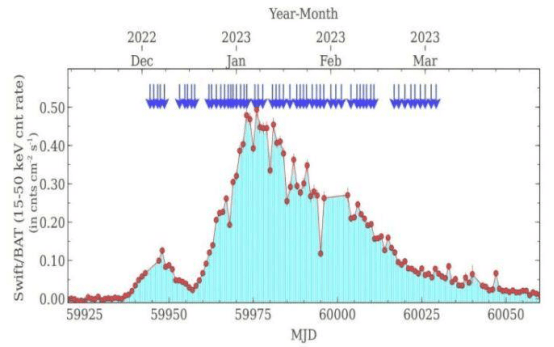
RX J0440.9+4431, a Be/X-ray binary, has been a subject of great interest since its discovery in the 1997 ROSAT Galactic Plane Survey. The system contains a pulsar located about 8,000 light-years from Earth, with an X-ray pulsation period of 202.5 seconds. From late December 2022 to March 2023, RX J0440.9+4431 underwent a giant outburst. Researchers Prahlad R. Epili and Wang Wei from Wuhan University decided to observe it with the Insight-HXMT telescope to investigate its X-ray spectrum and temporal variability.
The observations revealed that during the rising and declining phases of the outburst, the pulse profile shapes were similar at comparable luminosities, indicating a strong luminosity dependence of the pulse profile in RX J0440.9+4431. During the outburst, the net X-ray luminosity in the 1–120keV range varied between 4.4 and 28 × 10³⁸erg/s, and the phase-averaged spectrum could be explained by an absorbed cutoff power-law continuum model. Additionally, high-cadence hard X-ray observations revealed variable cyclotron resonant scattering features, and a second cyclotron line was discovered during the decline phase. The study also indicated that the pulsar in RX J0440.9+4431 has a relatively strong magnetic field that varied throughout the outburst, ranging from 4.8 to 15.4 × 10¹² Gauss. “Insight-HXMT observed this source at multiple stages of the 2022–2023 outburst. We used these bright observations of the pulsar outburst to study its X-ray spectrum and timing properties,” the researchers wrote in the paper.