
Astronomers from Yonsei University in Seoul, Korea, and other institutions have reported the discovery of a new isolated early-type dwarf galaxy that appears to have escaped from its galaxy group environment. The discovery paper was published on the arXiv preprint server on August 28.
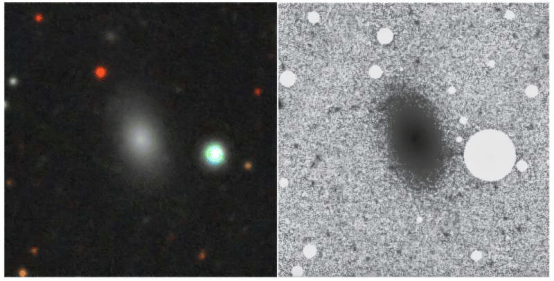
Dwarf galaxies are low-luminosity, low-mass stellar systems typically containing billions of stars. Among them, early-type dwarf galaxies (dE) are the most common type in nearby galaxy clusters and groups.
The recent discovery of isolated early-type dwarf galaxies (those not belonging to any galaxy cluster or group) has reignited debate about their formation. Some speculate that some of them may be “escaped” dwarf ellipticals (dE)—remnants ejected to the edge of or beyond the virial radius after a close passage through a galaxy group or cluster, during which they were tidally stripped.
Now, a team of astronomers led by Sanjaya Paudel from Yonsei University has identified what appears to be a runaway dE by analyzing data from various astronomical surveys, including the Sloan Digital Sky Survey (SDSS).
The scientists wrote in the paper: “In this study, we report the discovery of a dE, SDSS J011754.86+095819.0 (hereafter dE01+09), which appears to be located far from its host group.”
According to the study, dE01+09 is currently situated in an almost isolated region, projected to be about 3.9 million light-years from its possible host galaxy group NGC 524. It is a quiescent galaxy exhibiting typical morphological and stellar population characteristics of dE galaxies. Overall, its stellar population structure is uniform, with no evidence of recent central star formation.
The study found that dE01+09 has an effective radius of approximately 3,900 light-years and a mass of about 280 million solar masses. The age of the galaxy is estimated at 8.3 billion years, with a metallicity measurement of –1.19 dex.
To explain the origin of dE01+09, the astronomers hypothesize that it was once a member of the NGC 524 galaxy group, later ejected, and evolved into an isolated system within the group. They consider the most plausible scenario to be that dE01+09 entered the group as a star-forming dwarf billions of years ago and underwent environmental quenching there.
The paper’s authors add that after quenching, dE01+09 continued to orbit within the group for billions of years. Then, approximately 3.5 billion years ago, a strong dynamical interaction likely occurred, bringing its velocity close to the group’s escape velocity and ejecting it beyond the virial radius.
Summarizing the findings, the researchers emphasize that the presence of a quiescent dwarf like dE01+09 in such an isolated environment is unusual; therefore, further study of dE01+09 can help us better understand the nature of these rare dEs.