
Scientists have discovered that Mars' internal structure is similar to Earth's. Results from NASA's InSight lander indicate that the red planet has a solid inner core surrounded by a liquid outer core, potentially resolving a long-standing mystery.
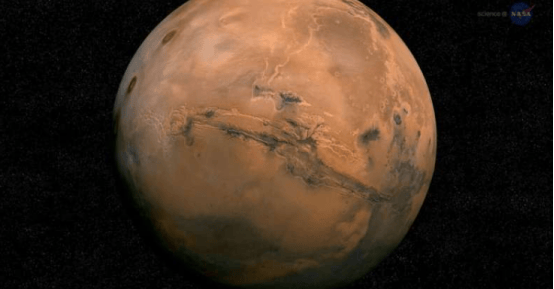
This study was published in Nature and is of great significance for understanding Mars' evolutionary process. Billions of years ago, the planet may have had a thicker atmosphere, allowing liquid water to flow on its surface.
This thicker atmosphere was likely sustained by a protective magnetic field, just like on Earth. However, Mars today lacks such a magnetic field. Scientists have long suspected that the red planet's atmosphere gradually escaped into space over time, turning it into the cold, dry desert we see now.
One key feature of Earth is its core, consisting of a solid inner core and a liquid outer core. Convection in the liquid layer forms a dynamo, generating a magnetic field. This magnetic field deflects charged particles ejected from the Sun, preventing them from stripping away Earth's atmosphere over time and enabling the habitable environment we know and enjoy.
Based on the remnant magnetization in the crust, we believe Mars once had a magnetic field, possibly generated by a core structure similar to Earth's. However, scientists believe that at some point in its history, Mars' core must have cooled and stopped moving.
There is abundant evidence on Mars' surface that liquid water once flowed, suggesting the planet had a more habitable environment in the past. This evidence comes in many forms, including dried lake beds rich in minerals formed underwater and rugged valleys carved by rivers and streams. Yet today, Mars has a thin atmosphere and lacks the vast quantities of water needed.
The team from NASA's InSight Mars lander seismometer was the first to detect Mars' core and determine that it is still liquid. Now, the latest research results from Bi Huixing and colleagues at the Hefei branch of the University of Science and Technology of China indicate that there may be a solid layer inside this liquid core.
The true nature of Mars' internal structure has long been a fascinating mystery. Did it once have a dynamic liquid layer surrounding a solid center, just like Earth? Or did Mars' smaller size prevent such a structure from forming? How large does a planet need to be to be protected by a magnetic field like Earth's and maintain a habitable climate?
To understand Mars' evolutionary history, we need to understand its present state. These questions about Mars' atmosphere, water, and core have driven several high-profile Mars exploration missions. NASA's Mars rovers Spirit, Opportunity, Curiosity, and Perseverance have studied the mineralogy of Mars' surface; the European Space Agency's ExoMars Trace Gas Orbiter is studying the water cycle; NASA's MAVEN spacecraft is studying atmospheric loss to space; and NASA's InSight lander was sent to study seismic activity.
In 2021, Simon Stähler and colleagues from ETH Zurich published a pioneering paper on the InSight mission. In the paper, they analyzed how seismic waves generated by marsquakes near InSight traveled through Mars: through the mantle, through the core, then reflected on the other side of Mars and reached InSight.
They detected evidence of the core's existence for the first time and were able to determine its size and density. They modeled a core with only one liquid layer that was larger than expected but less dense, and without a solid inner core. The core was huge—about half of Mars' radius (1,800km)—and the low density meant it was full of lighter elements. Light elements like carbon, sulfur, and hydrogen would alter the melting temperature of the core and affect how it crystallizes over time, making it more likely to remain liquid.
The discovery of a solid inner core (radius 610km) by Bi Huixing and colleagues is significant. The very existence of a solid inner core indicates that, as the planet gradually cooled, crystallization and solidification were occurring inside.
Mars' core structure is more similar to Earth's, making it more likely that it once had a “dynamo.” On Earth, it is the heat flow between the solid inner core, liquid layer, and mantle that drives convection in the liquid layer, generating the “dynamo” that produces the magnetic field. This result makes it more plausible that Mars once had a “dynamo.”
Simon Stähler and co-authors reported a fully liquid core, while Huixing Bi and colleagues reported a solid inner core—this might seem controversial. But it is not. It is an excellent example of progress in scientific data collection and analysis.
Competing Models of Mars
InSight landed in November 2018 and made its last contact with Earth in December 2022. Since Stähler's paper in 2021, we have received some new data from InSight. In 2023, Henri Samuel and colleagues from Université Paris Cité revised Stähler's model. The revised core size and density help reconcile InSight's observations with some other evidence.
In Stähler's paper, it was explicitly stated that the possibility of a solid inner core was not ruled out. The authors noted that the signal strength in the analyzed data was insufficient to identify seismic waves crossing the inner core boundary. It was an excellent first measurement of Mars' core, but it left questions about other layers and structures.
In the latest study published in Nature, scientists obtained this result by carefully selecting specific types of seismic events at a certain distance from InSight. They also employed some novel data analysis techniques to extract weak signals from instrumental noise.
This result is bound to have an impact in the academic community, and it will be very interesting to see further reanalysis of InSight data that either supports or refutes their model. Next, we will delve into the broader geological context and whether this model fits other available data constraining core size and density.
Understanding the internal structure of planets in the solar system is essential for comprehending their formation, growth, and evolution. Before InSight, people had studied Mars models similar to Earth, but the results were not satisfactory.