
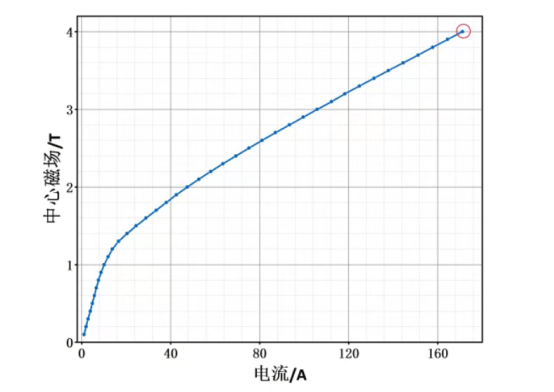
On August 20, the high-temperature lithium-lead comprehensive experimental platform developed by the Southwest Institute of Physics (SWIP) of China National Nuclear Corporation was fully completed and put into operation. The platform achieves a magnetic field strength of up to 4 T and a Hartmann number on the order of 10⁴, covering for the first time the typical operating parameter range of fusion reactor cores. It is a key facility for research on liquid metal applications in fusion reactors and leads the world in overall performance. The platform enables simultaneous validation of magnetohydrodynamic (MHD) effects in liquid blankets/first walls and in-situ mechanical performance testing in flowing lithium-lead environments, providing critical data support for future fusion reactor construction.
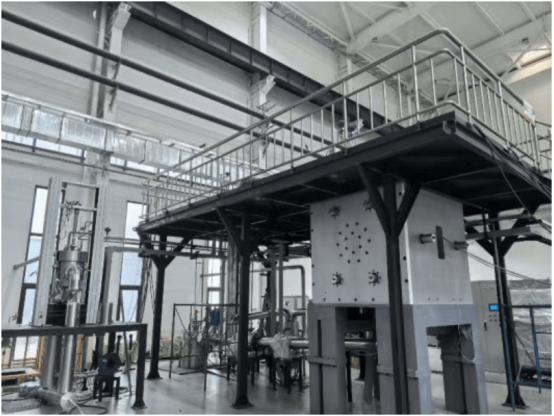
The engineering application of liquid metals in magnetically confined fusion reactors has long been constrained by two major technical bottlenecks: extremely high MHD pressure drops and corrosion embrittlement of structural materials, with no mature solutions available to date. The commissioning of the high-temperature lithium-lead platform not only creates a world-leading component-level MHD effect validation environment but also provides irreplaceable experimental conditions for material compatibility research, significantly strengthening China's technological reserves in liquid blankets and first walls, and laying a solid foundation for the engineering implementation of liquid blankets in fusion reactors.
The Liquid Metal Loop Laboratory was established in 1991 and was the first to build China's initial large-scale experimental platform for liquid metal blanket/first wall MHD effects. It remains one of the few laboratories worldwide capable of obtaining real flow data for liquid metals under strong magnetic fields. The laboratory has consistently focused on the two strategic directions of liquid metal blankets to solve the fuel self-sustainment problem in fusion reactors and liquid first walls to address material irradiation issues. Currently, the laboratory has constructed multiple normal-temperature gallium-indium-tin and high-temperature lithium-lead loops, supporting both fundamental research and engineering testing. It enables systematic study of liquid metal MHD effects, heat transfer, and corrosion performance, providing comprehensive support for future fusion reactors to overcome challenges in fuel self-sustainment and energy extraction.