
A research team from the Ulsan National Institute of Science and Technology (UNIST) in Korea has recently published groundbreaking results in Advanced Functional Materials, successfully developing an ultra-thin transparent smart film that generates electrical signals solely through mechanical peeling or pressing actions. This breakthrough technology opens new pathways for battery-free smart sensor systems.
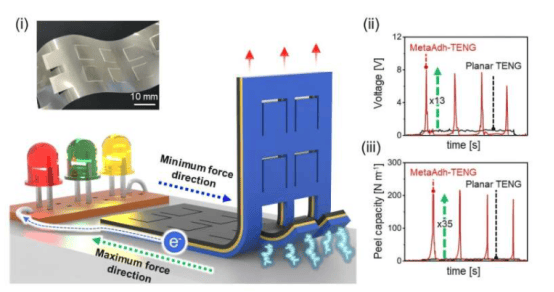
The study was led by Professor Hoon Eui Jeong’s team from UNIST’s Department of Mechanical Engineering. By integrating specially designed cutting patterns into an adhesive film, the researchers harnessed the triboelectric effect to convert mechanical energy into electrical energy. First author Hee Jin Lee stated: “The specific cutting pattern guides crack propagation, enabling rapid and controllable separation that maximizes electrical output.”
The team adopted a unique cut design resembling the Korean letter “ㄷ” (rieul), which increased the film’s adhesion by more than 35 times and boosted electrical output by approximately 13 times. This innovative structure allows simple pressing or peeling actions to generate sufficiently strong electrical signals. Professor Jeong noted: “This technology transforms a simple adhesive film into a battery-free smart self-powered sensor.”
The team demonstrated various practical application scenarios for the technology, including door access warning systems, anti-drop monitoring for valuable items, and anomaly detection in industrial equipment. When attached to a conveyor belt, the film can precisely identify abnormal states such as reverse rotation and trigger automatic shutdown. Professor Jeong added: “Its multifunctionality makes it suitable for a wide range of fields, including wearable sensors, anti-theft systems, and industrial safety applications.”
By adjusting the direction and arrangement of the cutting patterns, the researchers achieved programmable control over the film’s electrical response and adhesion performance, providing new ideas for designing smart sensing materials. This self-powered sensing technology holds broad application prospects in areas such as security monitoring and industrial automation.