
Simulating quantum systems and developing systems that harness quantum mechanical effects for computation rely on the ability to arrange atoms into specific patterns with high precision. To arrange atoms into ordered arrays, physicists typically use optical tweezers—highly focused laser beams capable of trapping particles.
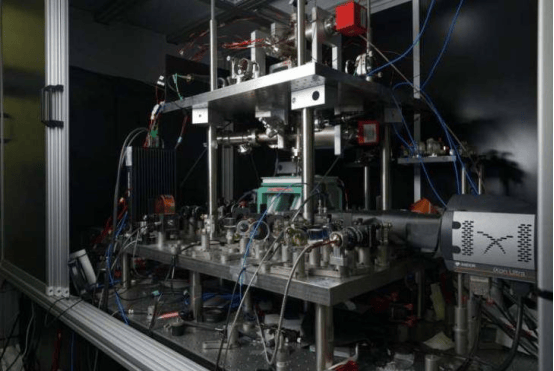
Researchers from the University of Science and Technology of China and the Shanghai Artificial Intelligence Laboratory have recently introduced a new artificial intelligence (AI) protocol that can arrange thousands of atoms into arrays while ensuring these arrays are defect-free (i.e., no missing atoms).
In a paper published in Physical Review Letters, they describe their proposed method, which uses holograms projected through a device called a spatial light modulator (i.e., computer-generated optical holograms) together with an AI algorithm that plans the simultaneous movement of all trapped atoms to their desired positions, enabling fast real-time correction of the array.
“Our initial interest in neutral atom arrays actually stemmed from a fundamental curiosity about the century-long debate between Einstein and Bohr on the recoil-slit thought experiment,” co-senior author Professor Lu Chaoyang told Phys.org. “About five years ago, we began exploring how to use a three-dimensional atom trapped and cooled to the ground state by optical tweezers as a quantum-limited recoil slit to faithfully realize Einstein’s thought experiment. At the same time, we also recognized the tremendous potential of atom arrays as an elegant and beautiful platform for quantum computing.”
The latest study aims to combine artificial intelligence with quantum physics to address a well-known challenge in assembling atom arrays. One of the lead researchers, Dr. Zhong Hansen, was a student of Professor Lu and began working at the Shanghai Artificial Intelligence Laboratory after obtaining his PhD from the University of Science and Technology of China.
“We realized that AI for Science is becoming a powerful paradigm for solving complex scientific problems, and we have been in ongoing discussions with Han-Sen about this,” Lu said. “This prompted us to use AI to address a long-standing challenge in the field of atom arrays: how to rearrange large-scale atom arrays in an efficient, fast, and scalable way. This is a very good example of ‘AI4Q’ (AI for Quantum).”
Zhong, then a student in Lu’s research group, designed an AI-driven framework that plans the simultaneous movement of all atoms in the optical tweezer array. In the team’s experiments, the optical tweezer array is generated using a high-speed spatial light modulator (SLM), a device that imprints holograms onto an incident laser beam.
“We use an AI model to compute the holograms that enable real-time rearrangement of the atoms,” Zhong explained. “By precisely controlling the position and phase of the tweezer array, all atoms can move simultaneously. In the experiment, we demonstrated the assembly of defect-free two-dimensional and three-dimensional atom arrays of up to 2024 atoms in just 60 milliseconds. Notably, the time cost remains constant regardless of array size, making the method easily scalable to 10,000 or even 100,000 atoms in the future.” The method proposed by the researchers analyzes a randomly loaded atom array and calculates the optimal paths for moving atoms loaded in the optical tweezers to the target positions of missing atoms. This path is then divided into a series of underlying steps.
“The entire path is divided into N steps. For each small step, we use the AI model to compute the SLM hologram and precisely control the position and phase of the optical tweezer array,” Zhong said. “All atoms move synchronously in real time. Our approach achieves high parallelism, thereby enabling fast and constant-time performance.”
A standout feature of the team’s method for assembling defect-free neutral atom arrays is its ability to move all atoms in parallel, resulting in defect-free arrays. This contrasts sharply with previously introduced methods that move atoms sequentially.
“Regardless of array size, we achieve fast and constant-time rearrangement,” Lu said.
This research opens new possibilities for realizing quantum systems composed of defect-free atom arrays, which in turn can be used to reliably perform quantum simulations or computations.
“Our next goal is to demonstrate quantum error correction and fault-tolerant quantum computing based on atomic qubits,” co-senior author Professor Pan Jianwei added.