
To support long-term lunar missions, meet astronauts' needs for food and oxygen, and reduce the high costs of transportation from Earth, a research team from the Technical University of Munich conducted an in-depth analysis of the feasibility of constructing photobioreactors (PBRs) using local lunar resources. The research results were recently published in the journal Acta Astronautica.
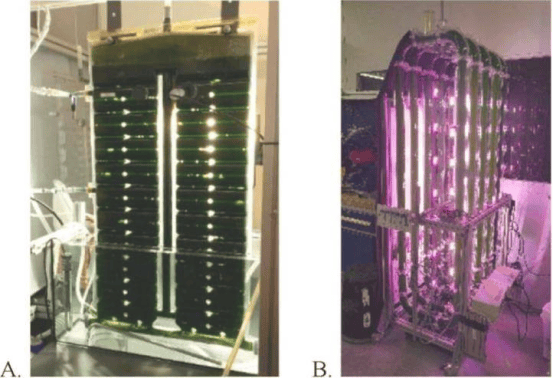
The photobioreactor (PBR) concept is based on closed biological systems, such as algae, which are provided with essential raw materials for survival like carbon dioxide and water, while collecting “waste” products such as oxygen and algae biomass. A well-designed PBR, especially with appropriate algae selection, can efficiently produce useful substances and minimize waste. However, the harsh lunar surface environment requires PBRs to be enclosed in protective systems to shield them from direct sunlight and other radiation. How to construct such protective systems using lunar resources was the focus of the study.
The research team considered two types of photobioreactors: tubular airlift systems and flat-panel airlift systems (FPA). FPA systems offer higher efficiency but come with correspondingly higher maintenance costs. Assuming high lunar launch costs, constructing either system can save millions of dollars, with tubular systems offering greater savings potential. Using local resources for construction could save up to $50 million. Research on producing metal materials from lunar regolith has made progress. However, algae inside the PBR require light, and internal lighting consumes significant energy, necessitating advanced components such as LEDs. External lighting requires a transparent glass shell, and manufacturing transparent glass from lunar resources remains a research challenge. Local production of electronic products like LEDs and plastic components also faces difficulties, though algae itself could potentially serve as a biological raw material for plastics.
Phosphorus is a key element for life and must be collected on the Moon to support long-term biological survival. However, elements essential for algae survival—such as carbon, nitrogen, and chlorine—are relatively scarce on the Moon. The study suggests recycling astronauts' wastewater to achieve closed-loop element utilization. To position PBRs as a key component of long-term lunar missions, the research team proposes a hybrid approach that combines traditional in-situ resource utilization (ISRU) methods for oxygen production with PBRs for food and oxygen generation.