
Scientists at the University of California San Diego have conducted a study that identified the formation of structural defects in diamond capsules used in nuclear fusion experiments under the extreme pressures required.
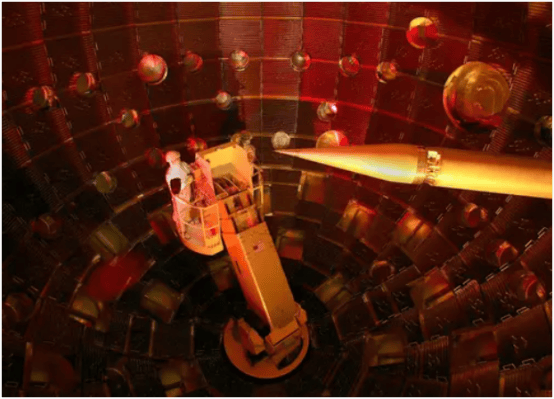
In a press release, the researchers stated that these findings will help guide improvements in capsule design and modeling to achieve more uniform implosions, thereby maximizing energy output in fusion experiments. The work is related to research at facilities such as the National Ignition Facility (NIF) at Lawrence Livermore National Laboratory, which is focused on inertial confinement fusion as a potential energy source.
In these experiments, powerful lasers compress diamond capsules containing deuterium and tritium fuel, with the goal of producing a symmetric implosion that subjects the fuel to the high pressure and temperature needed for nuclear fusion. The press release notes that by simulating extreme conditions with high-power pulsed lasers, the researchers discovered that diamond develops a series of defects, ranging from subtle crystal distortions to narrow regions of complete disorder or amorphization. These defects disrupt implosion symmetry, reduce energy yield, and can even prevent ignition.
The study details the physical processes occurring inside diamond over extremely short timescales. The laser-driven compression generates shock waves that, within about one nanosecond, produce high pressure and associated high shear stresses within the material. The researchers further explain that diamond is inherently a brittle material with limited dislocation activity under ambient conditions. This room-temperature brittleness makes it challenging to examine its behavior under shock conditions, and sample fragmentation complicates post-shock microscopic analysis.
The team conducted experiments on single-crystal diamond samples under varying shock pressures. Results showed that at 69 gigapascals (GPa), diamond exhibited only elastic deformation and retained a defect-free lattice. At 115GPa, high shear stresses generated defects in the structure, where stacking faults, dislocations, and twinning can help mitigate these defects.
This work marks the first experimental observation of shock-induced amorphization in diamond—a material response that had previously been predicted through molecular dynamics simulations but never seen in the laboratory. The study points out that materials like diamond, with an “open” crystal structure, are prone to structural collapse under pressure. Diamond’s cubic structure has a packing factor of 0.34, far lower than that of typical metals (0.68 to 0.74). The research emphasizes that shear stresses superimposed on hydrostatic pressure play a critical role in phase transitions and solid-state amorphization.
A deeper understanding of how and why these defects form provides valuable data for refining computer models that simulate the implosion process.